March 20, 2026
I spent 16 hours in a terminal and rebuilt my entire company's infrastructure
It started at 7 PM. I asked my AI coding partner to look at my setup. By 11 AM I had rebuilt everything. I planned an accordion.
It started at 7 PM on a Wednesday. I asked my AI coding partner to look at my OpenClaw setup and make some recommendations. By 11 AM Thursday I had rebuilt three production websites, migrated six services across hosts, set up dev/staging/prod environments for every project, switched my AI orchestration model, configured two-factor authentication, created CI/CD pipelines, released a new version of my open source project, deployed a monitoring system on a Hetzner server in Germany, written two blog posts, and researched manufacturing costs for a hardware product.
None of it was on the agenda. What I'd actually set out to do was build an accordion.
The first hour
My portfolio site had thirteen blog posts, and on mobile you had to scroll through all of them to reach the contact section. I wanted a collapsible section that showed four and expanded for the rest, a simple React component that should have eaten five minutes.
But a while back, my AI assistant Imogen had asked Claude Code to make a "minor update" to the site, and Claude Code rewrote the entire thing. All thirteen blog posts gone, hero section changed, pricing wrong. It deployed straight to production while I was driving to a meeting.
So hour one was disaster recovery instead. I restored from git, recreated eight blog posts from markdown files, and fixed a container naming dependency that was making the Cloudflare tunnel return 502. Along the way I learned the deploy process had zero guardrails.
Hours two through five
If the site could be destroyed by one vague task dispatch, the process was the problem, so I rebuilt the process.
Dev, staging, and prod environments for every project. DNS records created through the Cloudflare API. Traefik file-based routing rules. A deploy script that enforces the promotion chain: dev deploys freely, staging requires dev to be healthy, prod requires staging plus human confirmation, and feature branches are mandatory so nothing lands on main directly.
Then CI/CD. GitHub Actions on four repositories. Multi-arch Docker builds pushing to GHCR. Discord webhooks sending build notifications to the right channels. Watchtower polling every five minutes for new images and auto-restarting containers.
Then two-factor authentication. Authelia had been running for over a year with everything on single-factor, and it turned out it had supported TOTP the entire time. I had just never set any domain to the two_factor policy, so one config change secured eleven admin panels.
Then I moved Mission Control, my ops dashboard, from the Mac Mini to the Docker host, because the Mini only has 16 gigs of RAM. I reduced Plex from 32 gigs to 8 (it was actually using 777 megabytes), set up PBS backups for all VMs and containers, and protected everything on Proxmox from accidental deletion.
The model switch
While debugging why my AI assistant couldn't dispatch tasks through Discord, I found that the OpenAI OAuth token had been silently expired for thirteen days, long enough that nobody had noticed.
That made me question the orchestration model itself. Kimi K2.5 through the Alibaba Coding Plan was routing every API call through Singapore, ten-plus seconds of latency per decision.
I had benchmarked NVIDIA's Nemotron models months earlier and dismissed them because they didn't work through a proxy I was using. That night I tried Nemotron 3 Super 120B through NVIDIA's direct API and got three-second responses.
Switching wasn't clean. OpenClaw uses a slash to separate provider from model ID, but NVIDIA's API wants the provider name as a prefix in the model field too, so I had to name the provider nvidia-nim to avoid double-prefixing, which cost me three hours of debugging a naming convention.
The HomelabARR release
HomelabARR CE had a structural problem. It had two completely separate app systems: 160 hardcoded template apps with pretty icons but no deployment capability, and 121 CLI apps from YAML templates that could actually deploy but had no icons. Two different deploy modals, two different data sources, mismatched app counts.
So I killed the template system. I deleted 3,394 lines of hardcoded data, built an icon mapping layer, and made every category tab fetch from the backend API. That collapsed it down to one source and one deploy flow.
Then I found that the YAML templates used environment variables for Docker image names (things like JELLYFINIMAGE and SONARRIMAGE), but the deployment engine didn't set defaults for any of them. I dug up the original .env file from August 2025 with all the LinuxServer.io image references and ported every default.
Then local mode deployment didn't work, because the templates assumed Traefik infrastructure. So I built a YAML rewriter that strips external network declarations, Traefik labels, and security options on the fly before passing the compose file to Docker.
Then the default password was wrong, because the compose file set it to CHANGE-THIS-PASSWORD while the code defaulted to admin. Two different defaults depending on how you deployed, and that one had already cost me two hours the previous night.
Then the frontend was calling localhost:8092 for API requests, which only works when the browser is on the same machine as the backend. I changed every fetch call to use relative URLs through the nginx proxy.
Then the EventSource for deployment progress streaming was connecting to /stream/progress instead of /api/stream/progress, so it was getting HTML back instead of an event-stream.
Then the progress-stream.js had its own deploy mode switch that didn't include a case for local mode.
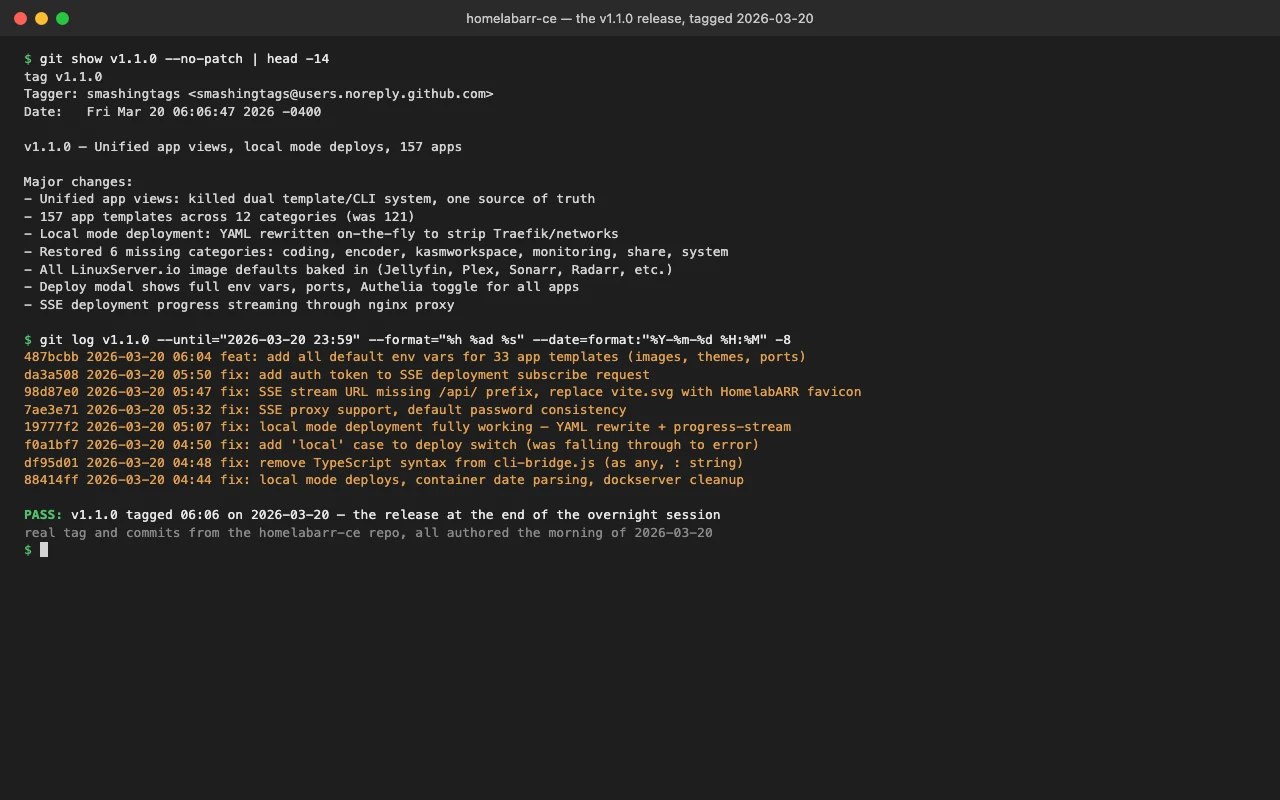
I fixed all of it, released v1.1.0, tagged it, created a GitHub release, and announced it in two Discord servers.
The demo isolation
The CE demo was running on my production Docker host alongside 55 other containers. Someone deploying Plex through the demo would have conflicted with my actual Plex. So I created an isolated LXC on Proxmox, installed Docker, deployed CE into it, updated the Cloudflare tunnel, and removed CE from production.
Then I deployed nine apps through the demo to verify the full flow works: Plex, Jellyfin, Sonarr, Radarr, qBittorrent, Tdarr, Dozzle, Homepage, Diun, all of them running in the isolated container.
The monitoring
Deployed Uptime Kuma on the Hetzner hosting server, eight monitors covering every public service, and a branded status page. Then I found Cloudflare was blocking the health checks with JS challenges, because the Hetzner IP looked like a bot. Created WAF allow rules on three Cloudflare zones and everything went green.
The other stuff
Somewhere in there I also fixed a display resolution issue that had been bugging me for months. My Mac Mini connects to my Windows desktop via Parsec, but the HDMI dummy dongle only advertised 1920x1080 at 60Hz. I created a macOS display override to add 3440x1440, installed displayplacer, and set up a LaunchAgent to auto-configure the ultrawide resolution on boot.
Then I researched manufacturing a programmable HDMI dongle as a hardware product. Nobody sells one in the $29-49 range, the BOM cost is about three dollars, and the margins are around ninety percent, so I made a task on the board.
Then I found my old Claude Discovery Lab in Confluence, an autonomous research space where I used to give Claude scheduled sessions to explore whatever it found interesting. It had produced work in MCP server integration, 3D printer automation, and workflow orchestration, and all of it is still sitting there.
The numbers
Sixteen hours. Twenty major infrastructure changes. One hundred twelve tasks closed on the board, most carried over from previous sessions but a solid chunk from that night. Four repositories picked up new CI/CD pipelines. I shipped a 1.1 release of an open source project, two blog posts, a status page, an isolated demo environment, an orchestration model switch, three Cloudflare WAF rules, and eleven panels with two-factor auth. One accordion.
I run my company the way I used to run engineering teams at a Fortune 500: sprints, story points, Jira boards, Confluence documentation. The difference now is an AI coding partner that executes at 3 AM without complaining, and infrastructure that lets me ship changes in minutes instead of weeks.
The cobbler's children finally have shoes. And, eventually, an accordion.