September 14, 2025
238 pages for a team of one
Sprint retrospectives with two attendees: me and my AI. RCAs for bugs nobody else would ever hit. A master index for a Confluence space only I will ever read.
The first page
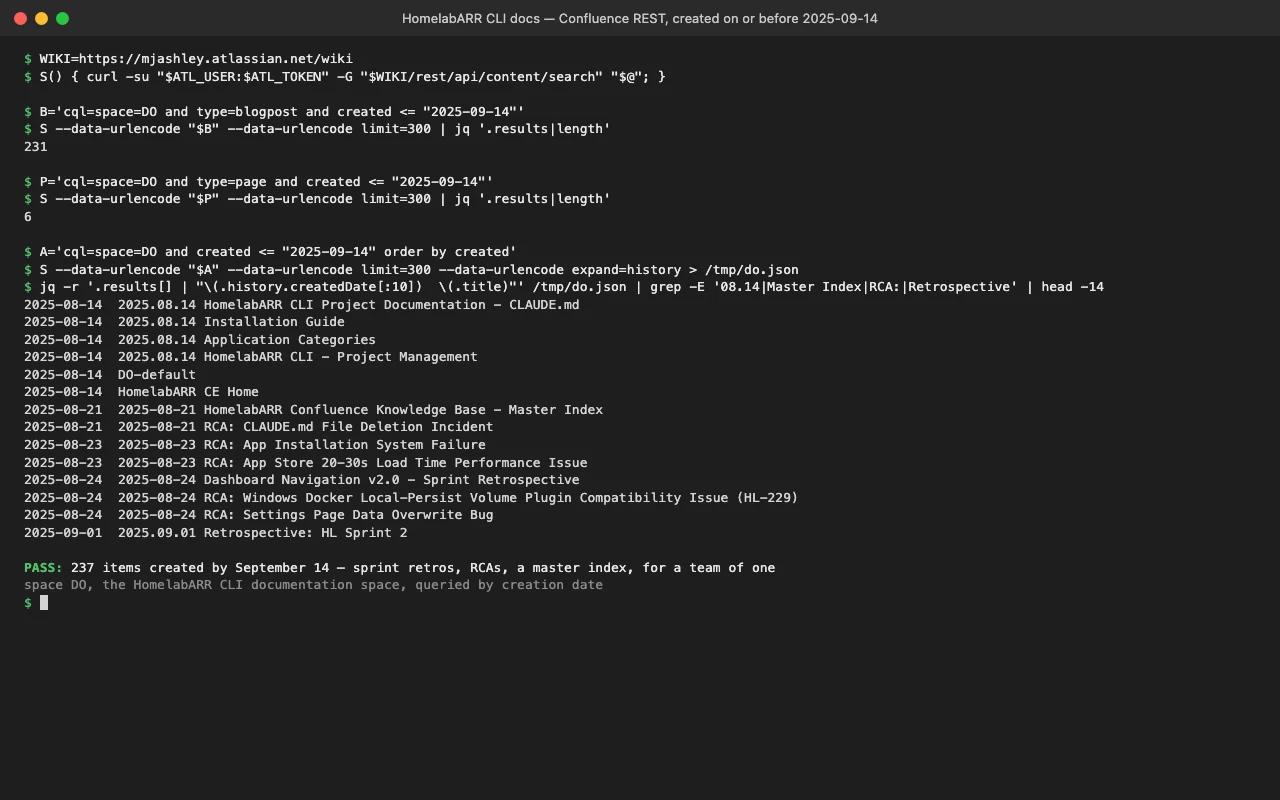
August 14th. Two weeks after getting fired. I opened Confluence and wrote the first documentation page for HomelabARR CLI. Project management overview. Development methodology. Story point definitions. The complete process flow: Local Notes → Code Changes → Confluence Docs → Jira Updates → GitHub Branch → Pull Request → QA → Done.
A process flow for a project with one developer, one QA tester, one product owner, and one architect, all the same person.
I defined 1 story point as 8 hours of head-down coding time. I set up a Jira board with proper swim lanes. I created sprint cadences. I wrote acceptance criteria for every ticket. Two weeks into unemployment, building processes for a team that doesn't exist.
18 pages in a day
On August 19th I wrote 18 Confluence pages. Container naming standardization. Branch reference modernization. Docker image migration plans. ARM64 build fixes. GHCR integration. Ubuntu 24.04 base image migration. Discord webhook documentation. Each one followed the same template: overview, implementation details, acceptance criteria, testing notes.
By August 24th I had written 32 more. Architecture deep dives. Docker Compose template catalogs. RCAs for bugs I'd found and fixed. A working-state page that captured what was functional and what wasn't at that exact moment.
Every decision got written down. Every bug got an RCA. Every sprint got a retrospective. If I stopped, the context would evaporate.
The retrospectives
The sprint retrospectives are the part that probably looks absurd from the outside. Sprint 5 retrospective, September 6th. Attendees: Lead Developer & Architect, AI Development Assistant (Claude), Strategic Product Owner. Three roles, one person, and an AI that doesn't attend meetings.
The retro documented 42 story points delivered across 9 stories with a 100% completion rate. It has a "What Went Well" section, a "What Didn't Go Well" section, and action items for Sprint 6. It has a "Team Recognition" section praising the strong work of a team of one at midnight.
The retrospective works, though, and not because anyone else reads it. Writing it forces me to think about what actually happened in the sprint versus what I thought happened. The "What Didn't Go Well" section catches things I would otherwise repeat. The action items give me a starting point for the next session. The velocity numbers tell me whether I'm shipping faster or slower, and why.
I ran retrospectives for twelve Scrum teams at Neptune. The format is muscle memory. Applying it to a solo project isn't ceremony for its own sake. It's the only way I know how to build.
The RCAs
I write formal root cause analyses for solo-project bugs. The settings page that silently overwrote user configuration with hardcoded defaults. The git clean -fd that deleted my project config. The files that got moved to archive folders during a reorganization and broke three core features.
Each RCA has a timeline, an impact assessment, a root cause section, contributing factors, and action items. It's the same format I used for production incidents at a company with hundreds of engineers, applied to a project where the production environment is a VM in my closet and the user base is me.
But the action items from those RCAs become the guardrails. "Mandatory dry runs before destructive commands" came from the git clean incident. "Verify file dependencies before reorganization" came from the archive incident. "Load current state before saving" came from the settings bug. Each one is a policy I would forget without the documentation.
238 pages
As of today I have written 238 Confluence pages across 14 categories. Architecture decisions, Docker integration docs, installation guides, frontend implementation notes, project management artifacts, security documentation, storage architecture, troubleshooting guides. A master index links all of them together with category headers and page IDs.
238 pages in six weeks, for a solo project. No team. No stakeholders asking for status updates. No compliance requirements demanding documentation artifacts. Just a PM's instinct that if it isn't written down, it doesn't exist.
Who it's for
I don't really know who the audience is. Realistically it's me. Maybe a future contributor if this project ever gets big enough to have one. Maybe a future version of myself who needs to pick up where I left off after a break.
That's who I'm writing for: the version of me who sits down at this codebase and doesn't remember why I made a decision, or which features are finished, or what broke and how I fixed it. That person will have 238 pages of answers instead of an empty Confluence space and a git log.
People would probably tell me I'm over-documenting, that a solo project doesn't need sprint retros and RCAs and a master index. They might be right. But I'm a PM who builds in bursts, and bursts end. When this one ends, the documentation is what stays.