November 21, 2026
A new box that would not make an array
Setting up my mini PC test box exposed a refusal in first-time setup, the soak turned out to be stalled, and I finally wrote down what is in the two app stores.
On November 21 I set up a new test box, a small Lenovo mini PC with an i5-7500T, 16 GB of memory, one SSD and one NVMe drive. I called it eightly-mini. I wrote the release candidate 5 stick image to a 31 GB USB stick, gave it a fixed address in the stick's answers file, and booted it. What I wanted was simple. The SSD as the array's data drive, the NVMe as cache, no parity.
The refusal
First-time setup would not create either kind of array without a parity drive. That held for SnapRAID with MergerFS and for 8RAID. Unraid lets you start an array with no parity, and it says so. Mine just stopped. I filed each refusal as a fault in the product, because a customer setting up the same box would hit the same wall, and the fix belongs in setup, not in a different route around it.
The install turned up more than a dozen other faults over the day, from the first screen to the restart. I recorded the console during a restart and found an error from efivarfs in the initrd. Starting from the stick takes about 5 minutes and 40 seconds end to end.
I also built a CI runner as a VM on the same box by copying the disk of the storage runner on my Proxmox test host. The disk is 7.5 GB and the copy took about four minutes. It resets to clean after every job, builds ISOs, and passed two builds.
The soak had been stalled
While I was checking on the 8RAID soak, I found that its pool was failed. The state was blocked with a driver error and unprotected. The box was still on release candidate 3, and the fix for a disk that returns with the same serial had merged on the 20th, days after that candidate was cut. The soak had been sitting broken.
Late in the evening I tagged candidate 6 on the dev head and started its release build. I made that tag before two data-loss fixes were in, one that makes a two-disk cache mirrored by default and one that stops setup offering array members as cache disks. Both were held on a merge conflict, and no release was published from that tag.
Cleaning the board, and writing down the app stores
I closed 25 tickets that were done, eight from QA and seventeen that I checked against the git history, and reopened one that had been closed wrongly. Then I had every one of the 161 open tickets read in full. Five were done but still open, about 29 could be cleared, and 127 were real work, roughly 69 of them bugs, data-loss risks or CI defects and about 69 planned features.
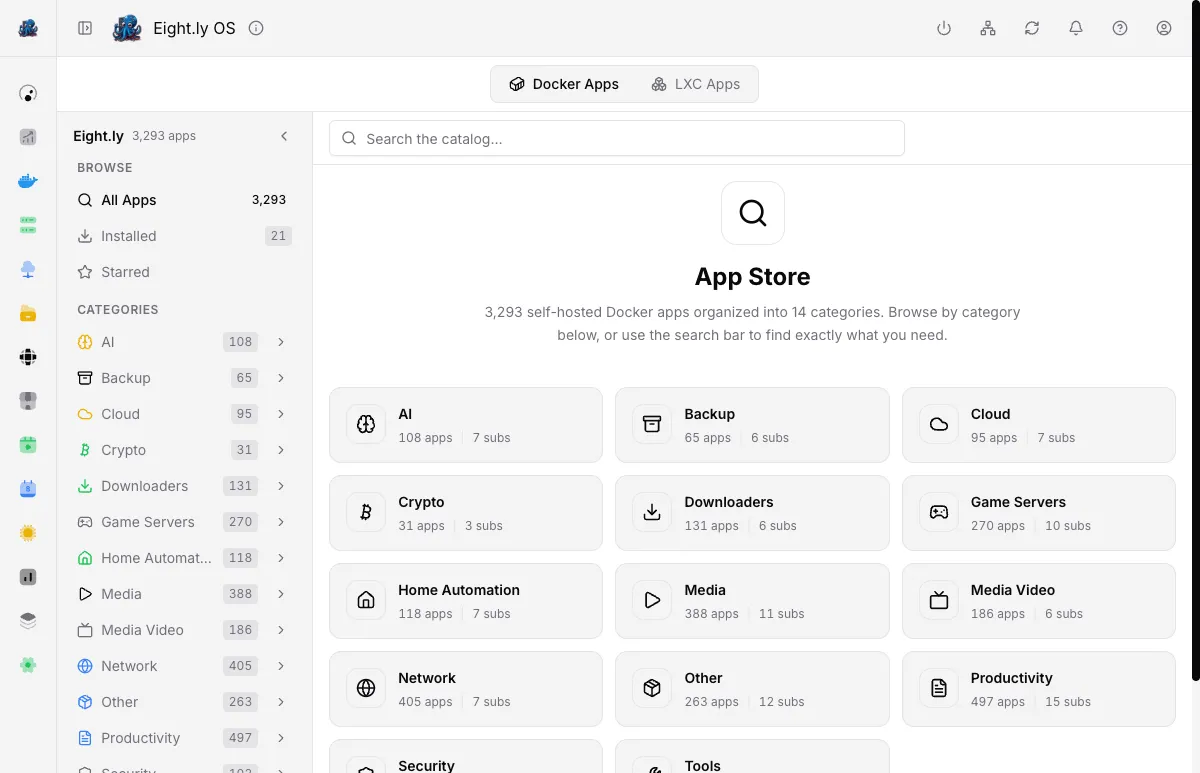
The larger piece of writing was the record of the two app stores, which I had described wrongly more than once because the facts were scattered across old notes. The Docker store was seeded from the Unraid Community Apps feed in April, cut to 3,246 apps on July 27 after I dropped miners, removed 98 dead images, repointed 263 and repaired wrong-app templates, and has 3,247 app folders now. Measured on main that day: 3,047 have an icon and 182 do not, and 790 have no author. Of the images, 1,543 are tagged latest, 1,195 are untagged and 577 are pinned. 96 apps ask for privileged mode, 157 use host networking and 104 bind the Docker socket. The LXC store has 561 apps, generated from a fork of the Proxmox community scripts, and was last refreshed on July 27.
The August install test is the only full measurement I have. Of the 3,246 apps, 1,018 answered on a port, 335 came up, 571 exited and 62 crash-looped. The installer refused 556, and 704 had no clean result, 545 of those because of network outages during pulls. A second finding is that the store's repository ran no scheduled jobs for about five weeks. I could not prove why, so I built a watcher outside GitHub that runs twice a day and checks for a heartbeat. When I fired it for real it opened an issue naming the two scheduled jobs that had failed on the 16th.
The LXC sweep began at 6 that evening, putting each of the 561 apps through the product's own install path. I moved it to a second test machine at 7, and it stopped by itself at app 53 because one container ignored the stop. A hard stop after two minutes and a restart-on-failure service fixed that. At 10 I parked both sweeps with 67 judged: 44 installed and answered, 11 installed and ran, 12 failed.
A five-seat model review looked at the LXC change and my plan for the stores, and I folded its fixes into the plan. The review made its own working copy of every repository on the Mac mini's internal drive and took it from 20 GB free to 7.8 GB. Heavy work like that now runs on the external drive only, through a script that refuses a large or internal folder.
Settings on the stick, and MemIndex 1.8.0
Two Eight.ly changes merged. New Config for 8RAID now offers Parity is already valid, a trusted start that keeps parity and starts no check by itself, and a new SnapRAID array gets a daily sync and a weekly scrub. Later, settings moved onto the USB stick as plain readable files, each at the path it has on the box, loaded before any service starts, so I can edit one on another computer.
MemIndex 1.8.0 went out in the morning. It adds your existing Codex sign-in as a fallback for note writing. The vector store recovers after a timed-out read, searches no longer wait indefinitely while the embedding model loads, and Chinese and Japanese terms are found in unspaced text. Distill keeps symbolic links such as an AGENTS.md pointing at CLAUDE.md. A new gate refuses to publish a release unless CI and the Windows run are green on the exact commit. I fired it on a red commit first, watched it refuse, and then proved a green one. Hosting went live on 1.8.0 after a backup and a proof against a restored copy of the live database, which I removed afterward.