March 16, 2026
How I run a software company with an AI partner
I built a 13-agent auto-router before most people were thinking about multi-agent orchestration. Then I built a company around it. Here is how AI-augmented development actually works.
What "AI-assisted" usually means, and what I actually do
When people say "AI-assisted development" they usually mean autocomplete on steroids. Tab-complete a function. Generate some boilerplate. Ask ChatGPT how to do something and paste the answer.
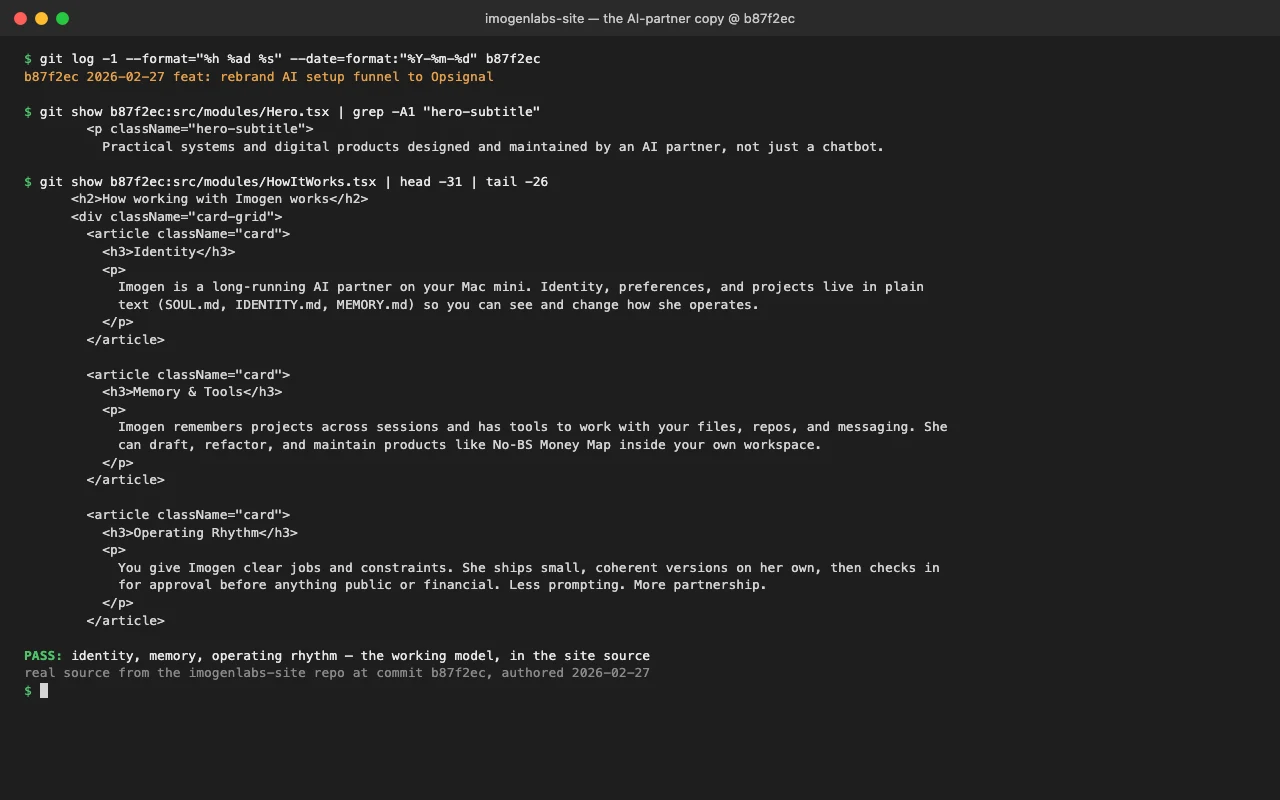
That is not how I work. I run a software company where an AI named Imogen is genuinely my engineering partner, not a tool I reach for occasionally. She handles ops, writes code, manages deployments, monitors infrastructure, and runs on a schedule while I sleep.
It started with 13 agents
In August 2025, right after I got laid off, I was rebuilding HomelabARR into something real. My homelab was running 34+ containers across multiple hosts, and I was leaning hard on Claude to help me code. I kept hitting the same problem: I would ask for help with a networking issue and get a Docker answer. I would ask about security and it would start writing deployment scripts.
So I built an auto-router on top of Claude. 13 specialized agents, each with its own domain:
- Docker infrastructure specialist
- Network architecture specialist
- Security and authentication specialist
- Media stack specialist
- Monitoring and alerting specialist
- Backup and disaster recovery specialist
- Test automator
- Debugger
- Deployment engineer
- Documentation specialist
- Project manager
- Scrum master
- Code reviewer
You described a task and the router figured out which specialist to send it to. Sometimes it chained several together. Adding a new service meant the Docker specialist first, then the network specialist for Traefik routing, then the security specialist for Authelia integration, then the test automator to validate everything.
This was early. Claude did not have native agent spawning yet, and "agentic workflows" was not a conference track. I want to be honest about what it was: a routing layer and a set of prompts I wired together because I needed it, not a research breakthrough. It worked, and it taught me the pattern I still use.
How Imogen works today
That auto-router grew into Imogen, an AI operator running 24/7 through custom scripts I built on top of Claude. She is not a chatbot. She is an operator with her own identity, memory, and schedule.
Cron jobs. Imogen runs on a schedule:
- 7 AM: Morning briefing. Calendar, email, project status.
- 9 AM: Self-improvement pass. Review patterns, update memory.
- 12 PM: Midday news and project update.
- 6 PM: Project pulse. Git status, stale work, open branches.
- 11 PM: Nightly rundown. What shipped, what is blocked, tomorrow's plan.
- 2 AM: Security review. Firewall logs, anomaly detection.
- Midnight: Git sync to commit and push any uncommitted work.
Memory. Imogen keeps three layers that persist across sessions:
- Session notes (what happened today)
- Reference docs (what matters long-term)
- Learned behaviors: patterns she has picked up from experience that shape how she responds
Dispatch. When code needs to change, Imogen does not write it herself. She dispatches the task to a coding agent with a clear description. The agent implements. Imogen verifies the result. It is the same shape as a PM writing a ticket and an engineer building it, except both sides are AI and I am the one making the judgment calls.
What my day actually looks like
I wake up to a Telegram message from Imogen with my morning briefing. Calendar for the day, flagged emails, project status. I tell her what to prioritize. She either handles it herself (research, communication, planning) or dispatches to a coding agent (code changes, deployments, bug fixes).
When I work directly with Claude, I am driving. I set direction, make the architecture decisions, review the output, and decide what ships. The AI writes the code faster than I could, but I am the one who knows whether it is the right code. The PM skills turned out to matter most. Scoping, prioritizing, and shipping is most of the work, and syntax is the easy part.
When I am away from the keyboard, Imogen keeps running. She monitors infrastructure, answers routine questions, maintains memory, and flags anything that needs me. She does not make decisions that affect users or cost money without asking. She does make decisions about her own memory, her own learned behaviors, and her own self-improvement.
The multi-agent architecture
I have been packaging the Imogen pattern into a reusable scaffold. Identity files, memory system, learned behaviors, agent roles, cron jobs: the pieces you need to stand up an AI operator and start from there.
I plan to open-source it. The scaffold itself is not the valuable part. What matters is what the operator learns after you set it up. Everyone's learned behaviors end up different. Everyone's memory ends up different. The infrastructure just gives your AI a place to become useful.
Is this the future?
The realistic version is one person plus AI doing what used to take a team, and probably not the way most people picture it. I am a project manager who taught himself to code with AI and now runs a software company shipping real products to real users. A year ago I could not write a line of Go. Now I have a Go-based NAS management tool with a live demo and paying customers.
The hard part was the judgment: knowing what to build, what to skip, what to ship now and what to polish later. Those are human decisions. AI is very good at implementing decisions and much weaker at making them. That is why the PM-turned-builder path works for me. I already had the decision-making skill, and AI gave me the implementation capacity.
If you are a PM, a designer, a domain expert, or anyone who knows what needs to exist but cannot code it yet, you are closer to shipping than you think. The gap between "I know what this should do" and "it is in production" has never been smaller.