March 22, 2026
The archaeology of a fork
HomelabARR CE is built on a codebase that runs back through Dockserver, PGBlitz, and PlexGuide. Each era left something behind, and removing it is its own kind of work.
I did not write HomelabARR CE from scratch. It is built on a codebase with a long memory. The Docker Compose foundation came from Dockserver, which was doob187's clean-room rewrite of PGBlitz, which was a rebrand of PlexGuide, which is where I started years ago. Each of those eras left something behind in the templates and the docs, and a lot of what maintaining this project actually means is finding those things and deciding whether they still belong.
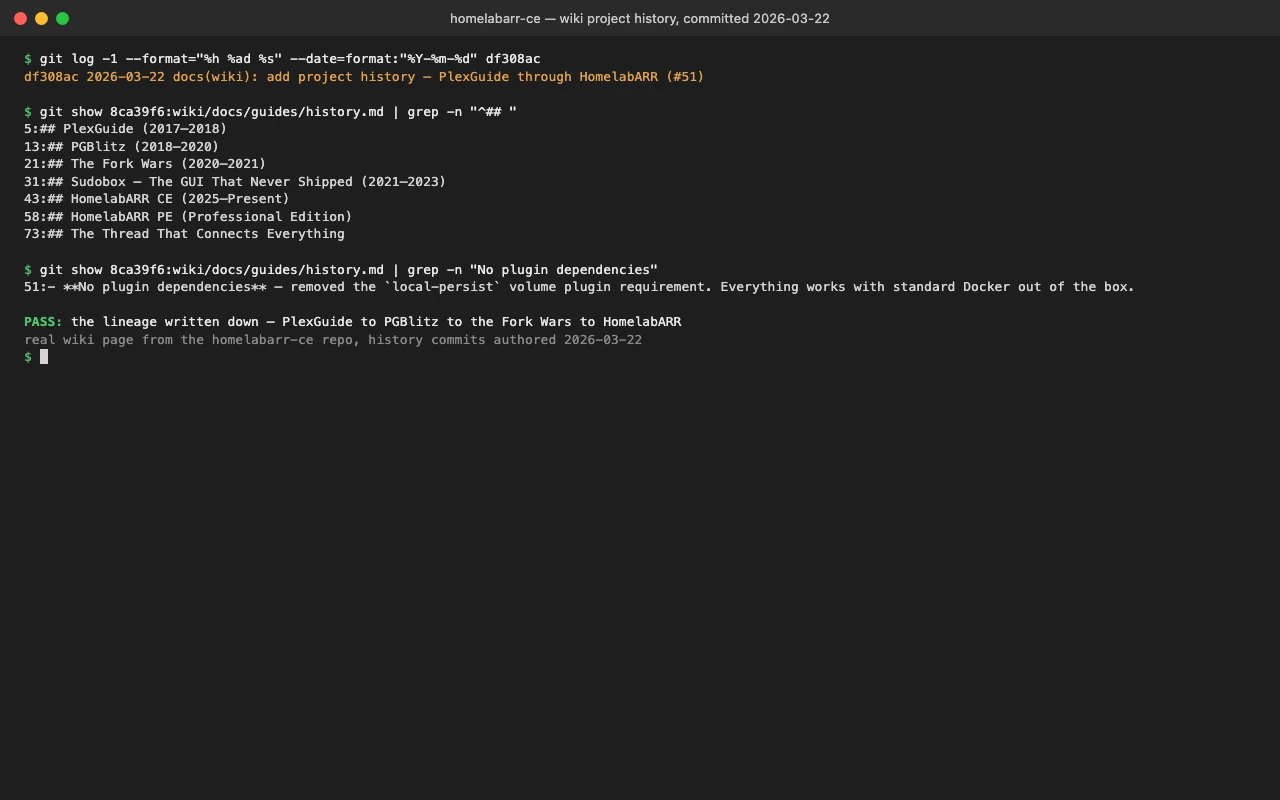
The lineage matters because it explains the artifacts. PlexGuide's whole reason to exist back in 2017 was streaming a media library off Amazon Cloud Drive, with rclone handling the mount and mergerfs stitching local and cloud storage into one path. When Amazon killed unlimited storage, the project pivoted to Google Drive. The cloud storage assumptions never fully left. Years and two rebrands later, the mount and uploader templates are still shaped around a workflow almost nobody runs anymore.
When I took over, I did not start rewriting. I started using it. I deployed it on a clean box, followed my own install instructions, and watched what broke.
The plugin
The first thing that broke was storage, and it broke silently. Dockserver leaned on a third-party Docker volume plugin called local-persist. Every app template declared its volumes with driver: local-persist, which only works if you have separately installed that plugin. A new user follows the quick start, runs docker compose up, and Plex refuses to create its volume. There is no log line that says "install the local-persist plugin." You just get a container that will not start. If you did not already know the plugin existed, you were stuck before you began.
So I ripped it out. Every template moved from the plugin to native Docker bind mounts. Here is the actual before and after, from apps/selfhosted/recipes.yml:
# BEFORE — requires the local-persist plugin installed out of band
volumes:
  staticfiles:
    driver: local-persist
    driver_opts:
      mountpoint: "${APPFOLDER}/recipes/staticfiles"
  nginx_config:
    driver: local-persist
    driver_opts:
      mountpoint: "${APPFOLDER}/recipes/nginx_config"
# AFTER — native Docker bind mount, no plugin
volumes:
  staticfiles:
    driver: local
    driver_opts:
      type: none
      o: bind
      device: "${APPFOLDER}/recipes/staticfiles"
  nginx_config:
    driver: local
    driver_opts:
      type: none
      o: bind
      device: "${APPFOLDER}/recipes/nginx_config"
That same change went across 77 app templates in one commit (6d6566c), and the commit message records the proof I ran for it:
77 app templates updated from `driver: local-persist` to `driver: local`
with `type: none, o: bind, device: <path>`. This eliminates the need to
install a separate Docker volume plugin. Apps deploy out of the box.

Validated on clean Ubuntu 24.04 LXC (Proxmox 183) — Plex starts and
mounts /mnt correctly with no plugins installed.
Same functionality, zero plugin dependency. The templates carry their own bind mounts now, so a clean machine deploys without a setup step nobody documented.
The dead dependency
Converting the templates was only half of it. The plugin itself was still in the repo. There was a local-persist-plugin.yml template, four install and manage scripts for it, an icon mapping, and test references that all assumed it was a real thing you would install. None of that was reachable anymore once the templates stopped asking for the plugin, but it was still sitting there, implying a dependency that no longer existed.
I deleted it in a follow-up commit (6c34009). The message is blunt about where it came from:
Removed:
- apps/system/local-persist-plugin.yml (template)
- scripts/install-local-persist-*.sh (4 install/manage scripts)
- Icon mapping reference in app-metadata.ts
- Test references in test-ecosystem.sh

local-persist was a Docker volume plugin from the dockserver era.
Modern Docker named volumes + bind mounts handle everything it did.
That is the archaeology in one commit message. A volume plugin from the dockserver era, kept alive by inertia through a rebrand, finally removed once I could show nothing reached it.
The layers
The plugin was the cleanest example. The rest of it is scattered through the docs and the metadata. The wiki still had a whole local-persist-integration.md setup page. The category names were inherited from Dockserver and meant nothing to a new user. There were Unraid Community Apps references and BBCode left in app descriptions from an earlier distribution channel, which I had to strip out app by app. Each one was a decision someone made years ago, under a different project name, that nobody had revisited because it was not breaking loudly enough to force the issue.
So I wrote the history down. There is now a project-history page in the wiki that traces the real chain: PlexGuide, then PGBlitz, then the fork wars after PGBlitz was abandoned, when doob187 split off Dockserver and a separate group continued as PTS-Team while Saltbox carried its own Ansible lineage. HomelabARR CE took Dockserver's Compose foundation and added the things none of them had: a web GUI, a CLI menu, and no plugin dependencies. I was on the original PlexGuide team, so a lot of this I lived through rather than researched. It is just the part of the story that was never written down in one place.
The rule
This is most of what maintaining inherited software actually is. Not new features. Not new integrations. Sitting with the codebase, using it the way a new user would, and removing the things that stopped belonging two project names ago.
The rule I keep now is simple: if I cannot explain why something is in the repo, it should not be in the repo. After all this the codebase is smaller than when I took it over and it deploys cleaner, because every dependency that is left is one I can account for instead of one I inherited.
The Professional Edition is a separate answer to the same problem. It is a complete rewrite in Go, a single binary with its own backend and storage layer, and it forks nothing. I did that so I could answer any question about any line without saying "I think that came from the Dockserver era." The inherited code was not bad. I just wanted to account for every line of it.