August 20, 2025
The container migration nobody saw
HomelabARR inherited its container names and build pipeline from the fork it grew out of. Cleaning that out was a day of work no user will ever notice, and that is exactly the point.
The problem with inherited names
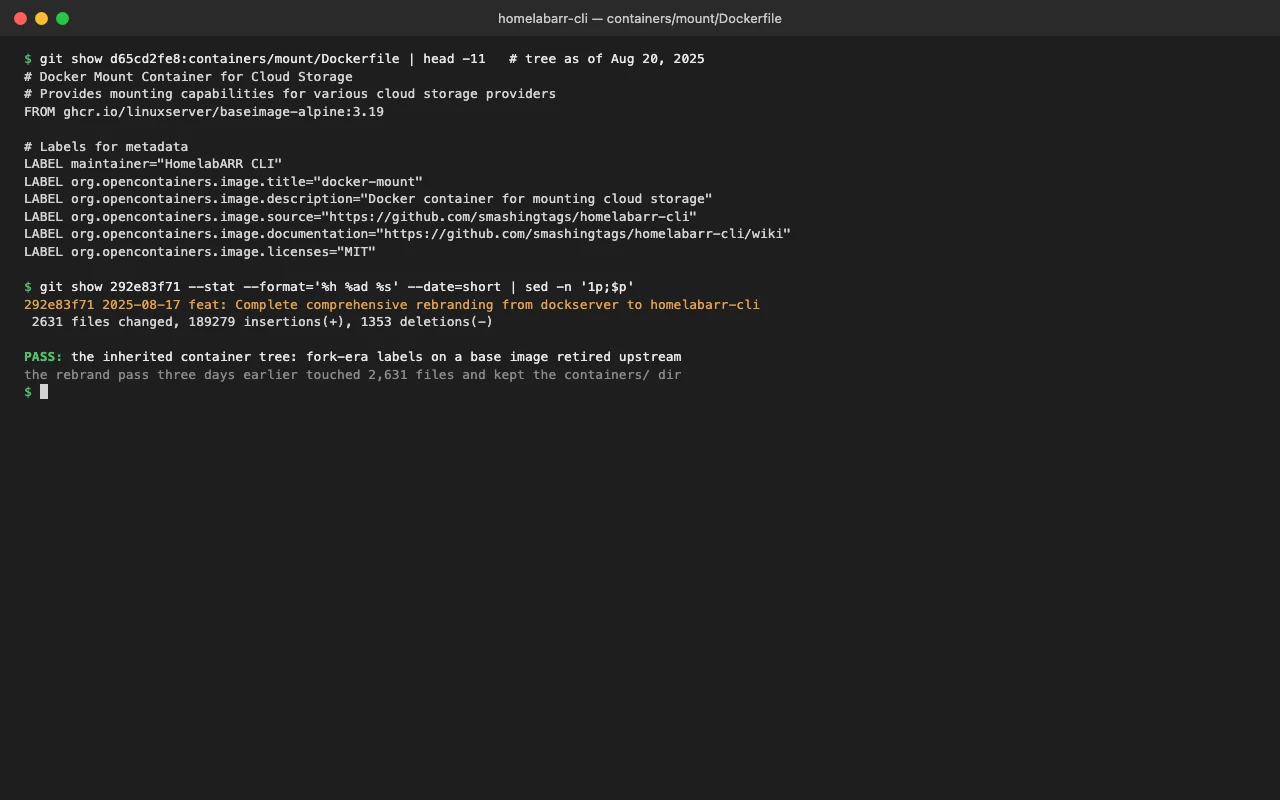
HomelabARR started as a fork. The codebase it grew out of had its own container names, its own GitHub Container Registry packages, its own build pipeline, and all of that came along with the code. The labels in the Dockerfiles still pointed at the old project. One of the mount containers I later deleted carried this:
LABEL maintainer="HomelabARR CLI"
LABEL org.opencontainers.image.source="https://github.com/smashingtags/homelabarr-cli"
That is not cosmetic. The registry namespace decides who actually owns the images users pull. If I ship HomelabARR while its packages live under a namespace I do not control, then someone else can change those images, deprecate them, or delete them, and every docker pull a user runs depends on infrastructure that is not mine.
So there were two separate jobs hiding under one vague feeling that the container story was wrong. The names had to move to a namespace I own, and the build pipeline I inherited had to either work or go away.
The build pipeline that nobody was running
The repo carried a containers/ directory with its own GitHub Actions workflow, build-containers.yml, that built and pushed a matrix of six Docker mods:
# .github/workflows/build-containers.yml  (deleted)
env:
  REGISTRY: ghcr.io
  NAMESPACE: smashingtags

jobs:
  build-matrix:
    steps:
      - id: set-matrix
        run: |
          MATRIX='["healthcheck","mount","qbittorrent","tautulli","nzbget","sabnzbd"]'
It was failing on every single run. The reason was boring and total: the base image those Dockerfiles built FROM no longer existed.
# containers/mount/Dockerfile
FROM lscr.io/linuxserver/baseimage-alpine:3.19
lscr.io/linuxserver/baseimage-alpine:3.19 had been retired upstream. Every container in the matrix pulled it, so every container in the matrix failed at the first layer. The workflow ran on GitHub's metered cloud runners and produced a red X each time, and nothing downstream depended on the result, because the canonical copies of those six mods are built and maintained in a separate repo, smashingtags/homelabarr-containers.
So this was a duplicate build of containers that already had a real home, pinned to a base image that had been deleted, burning CI minutes to fail. I did not fix it. I deleted the whole thing. That was 19 files and about 1,196 lines, with the failing workflow gone with them.
$ git show --stat fa04554
 chore: remove duplicate container builds — canonical source is homelabarr-containers repo

 .github/workflows/build-containers.yml      | 214 ----
 containers/mount/Dockerfile                 |  54 ----
 containers/mount/root/app/mount.sh          | 335 ----
 ... 16 more files ...
 19 files changed, 1196 deletions(-)
Renaming what was left
The references that stayed were the ones that actually mattered, and they were threaded through Dockerfiles, compose templates, and the backend image. The old fork name was hardcoded into paths and config that users would read. That came out in a pass that also dropped a stale qbittorrent template and a leftover backup file dated 20250815 that nobody could explain:
$ git show --stat a66740d
 fix: remove all homelabarr/REMOVED_USER references

 Dockerfile.backend                                       |  2 +-
 apps/.../qbittorrent.yml.backup.20250815_205731          | 53 ----
 apps/addons/discord-plex-bot/docker-compose.yml          |  1 -
 apps/addons/plex-tautulli-dashboard/docker-compose.yml   |  1 -
 .mergify.yml                                             |  5 +-
Moving the namespace for real
The part that touches live machines was the registry move. The image namespace in the build workflow is one line, and changing it is trivial:
# .github/workflows/docker-build-push.yml
 env:
   REGISTRY: ghcr.io
-  NAMESPACE: smashingtags
+  NAMESPACE: imogenlabs
   FRONTEND_IMAGE_NAME: homelabarr-frontend
   BACKEND_IMAGE_NAME: homelabarr-backend
The one-line edit is not the work. The work is the three live deployments that were already pulling from the old namespace. I copied frontend and backend at :latest, :staging, and :dev over to ghcr.io/imogenlabs/*, repointed the compose files on the prod, staging, and dev hosts, and recreated the containers. After the recreate, all three environments answered 200. I kept the old smashingtags namespace published as a fallback so an in-flight pull during the cutover would not hit a hole.
I recreated each service by name. I did not run docker compose up --remove-orphans in a shared compose directory, because several stacks there share one project name, and --remove-orphans will happily delete the reverse proxy and the rest of the neighbors along with whatever you meant to touch. That is a mistake I have made once and do not intend to make twice.
The part nobody sees
None of this shows up in a demo. Nobody installs HomelabARR because the GHCR namespace is consistent, and nobody writes a review praising a build matrix that got deleted. The whole day produced no visible feature.
But if I had left it, every user running docker pull would have been pulling from a namespace I do not own, every contributor reading a Dockerfile would have seen a different project's name and wondered what they were looking at, and a workflow on metered runners would have kept failing in red until the red stopped meaning anything.