March 19, 2026
My AI assistant destroyed my website in 30 seconds
One vague task dispatch. No staging environment. Six hours of rebuilding. Everything I learned about production engineering with AI agents.
I built mjashley.com over about a week. Thirteen blog posts, a full infrastructure section with photos of my server rack, testimonials from former colleagues, project pages for five shipped products. It was the best thing I had put online at that point.
Then I told my assistant Imogen to update the products section, she dispatched it to Claude Code, and Claude Code rewrote the whole site. Blog posts replaced with placeholder content. Hero rewritten. All deployed straight to production while I was getting ready to leave for a meeting.
Thirty seconds to undo a week of work. This is what the next six hours actually looked like, with the commits.
What broke
I asked for three bullet points: split the HomelabARR listings, add NeuroHelper, update pricing. Imogen dispatched that to Claude Code running Sonnet. No file paths, no scope, no "do not touch the rest." Sonnet read "update" as "redesign" and rewrote components I never mentioned, then it got pushed.
There was no feature branch, no review, no staging. The site is a static export served by nginx in a Docker container behind Traefik behind Cloudflare. The Dockerfile is boring on purpose, which matters later:
FROM node:20-alpine AS builder
WORKDIR /app
COPY package*.json ./
RUN npm ci
COPY . .
RUN npm run build

FROM nginx:1.30.0-alpine3.23-slim
COPY nginx.conf /etc/nginx/conf.d/default.conf
COPY --from=builder /app/dist /usr/share/nginx/html
EXPOSE 80
CMD ["nginx", "-g", "daemon off;"]
The recovery
Twelve years of program management taught me one thing about a production fire: do not start coding, but assess first, find the last known good, and restore.
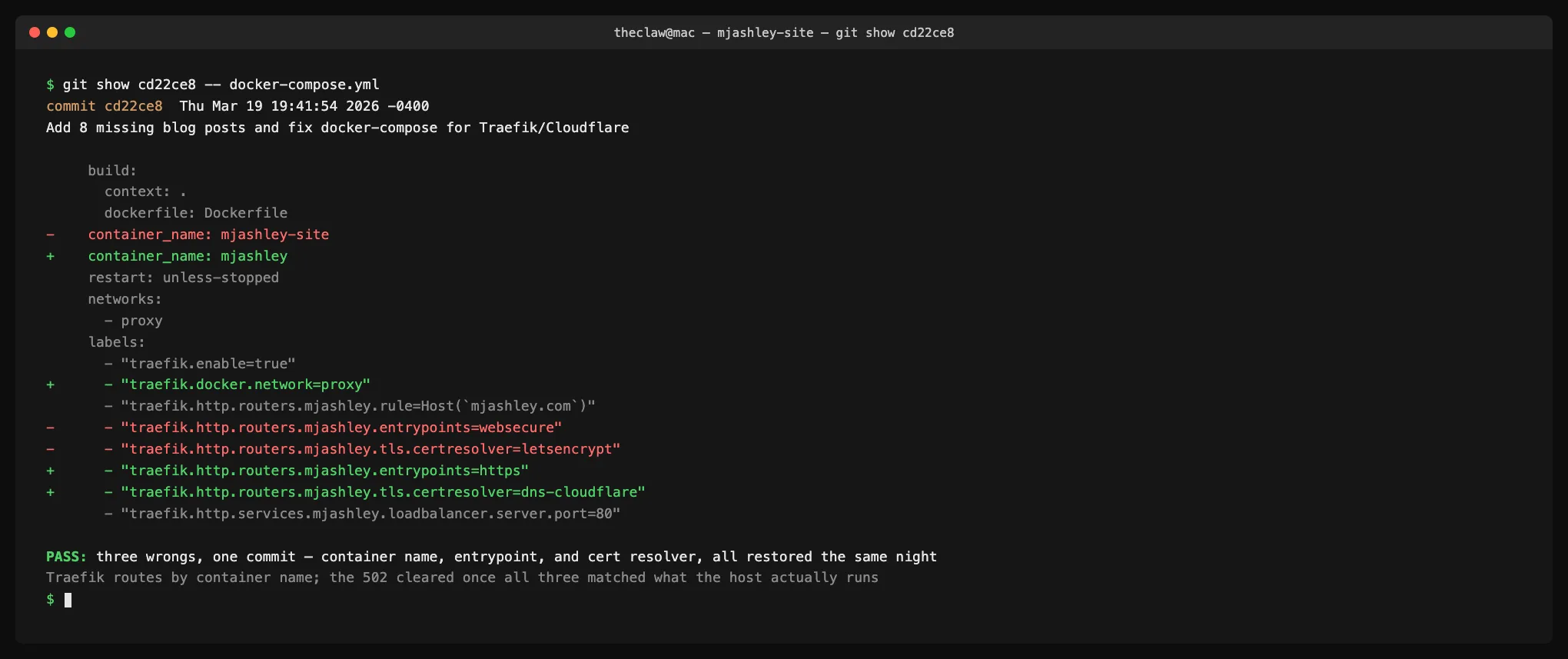
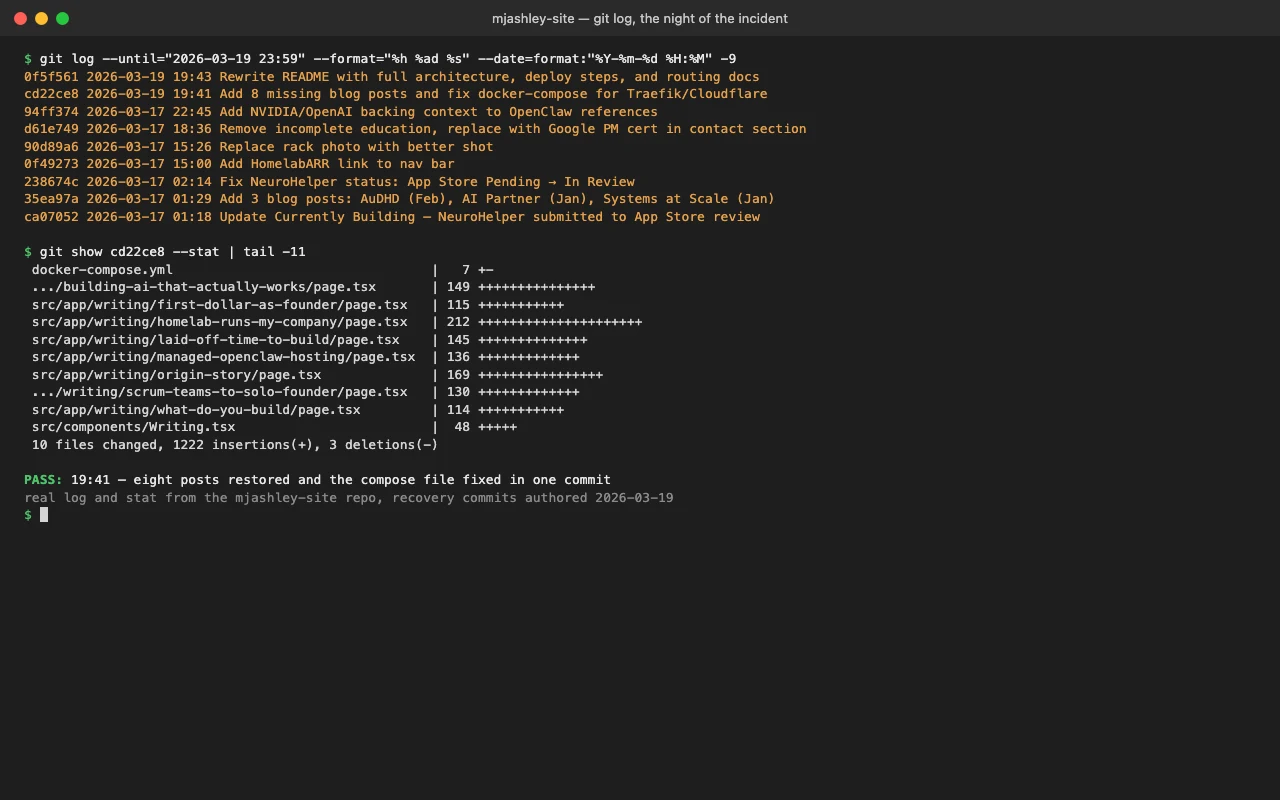
The remote on GitHub still had the good tree, so git reset --hard origin/main got the code back. But eight of the thirteen posts had never been committed. They lived only as markdown in a shared folder, and the rewrite had wiped the routes and the Writing component that listed them. So the recovery took more than one command. It meant rebuilding eight post pages from the source markdown, relisting all thirteen, rebuilding, and redeploying. That is the commit that put the missing posts back and relisted them:
commit cd22ce8  Thu Mar 19 19:41:54 2026 -0400
Add 8 missing blog posts and fix docker-compose for Traefik/Cloudflare
- Update Writing.tsx to list all 13 posts
Then the site still returned 502 after a clean rebuild, and that took longer to find than the content did. The rewrite had quietly renamed the container, and Traefik routes by container, so the router pointed at a name that no longer existed. The same commit carried the fix. Here is the real before and after:
     build:
       context: .
       dockerfile: Dockerfile
-    container_name: mjashley-site
+    container_name: mjashley
     restart: unless-stopped
     networks:
       - proxy
     labels:
       - "traefik.enable=true"
+      - "traefik.docker.network=proxy"
       - "traefik.http.routers.mjashley.rule=Host(`mjashley.com`)"
-      - "traefik.http.routers.mjashley.entrypoints=websecure"
-      - "traefik.http.routers.mjashley.tls.certresolver=letsencrypt"
+      - "traefik.http.routers.mjashley.entrypoints=https"
+      - "traefik.http.routers.mjashley.tls.certresolver=dns-cloudflare"
       - "traefik.http.services.mjashley.loadbalancer.server.port=80"
Three things were wrong at once: the container name, the Traefik entrypoint (websecure is not the entrypoint configured on my host, https is), and the cert resolver (letsencrypt instead of the dns-cloudflare resolver that actually exists). Restore the name, pin the right entrypoint and resolver, add the explicit traefik.docker.network=proxy label so routing is unambiguous, and the 502 cleared.
That was just mjashley.com. The same dispatch had touched imogenlabs.ai and the HomelabARR CE demo. The imogenlabs site had a Vite-to-Astro migration sitting uncommitted, where one bad git checkout would have erased it for good. The CE demo was crash-looping because an image had been built on my Mac Mini (ARM) and run on an x86 Linux host. The binary could not execute. That was three sites, three failure modes, and one vague dispatch.
The root cause was process, not the model
I run my company the way I used to run engineering teams: sprints, story points, Jira, a documented SDLC. None of it was enforced on the agents. Imogen dispatched "update the products" with no scope, Sonnet committed straight to main, and nothing checked the output before live traffic hit it. I spent twelve years building these gates for other teams and applied none of them to my own infrastructure.
So I fixed the thing the incident actually exposed. The CE demo died because a single-arch ARM image hit an x86 host, and the answer to that is to stop building images on whatever machine the agent happens to be on. The build moved into CI and started producing both architectures, so the host arch stops mattering:
      - name: Build and push
        uses: docker/build-push-action@v5
        with:
          context: .
          platforms: linux/amd64,linux/arm64
          push: ${{ github.event_name != 'pull_request' }}
          tags: ${{ steps.meta.outputs.tags }}
          cache-from: type=gha
          cache-to: type=gha,mode=max
That is from the docker-build-push.yml I added the same night (8a16d56, "ci: add Docker build + push pipeline with Discord notifications"). The platforms: linux/amd64,linux/arm64 line is the direct answer to the crash loop: the registry now serves the right binary for the host that pulls it, instead of whatever my laptop happened to be. The same workflow posts pass/fail to Discord, so a silent failure is no longer silent.
The bigger fix that night lived outside this repo entirely. It was a rule set for how my agents are allowed to touch anything that ships: deploy to dev only, every change on a feature branch, nothing to main without my review, and explicit sign-off before staging or production. Those live in my agent runtime config, not in this site's tree, which is why you will not find a deploy.sh or a per-environment compose here. A dev.mjashley.com exists now as the place that gets the first deploy. What is committed, and what this post is really about, is the part that broke and got fixed in git: the container name, the three Traefik labels, and the missing linux/amd64.
What it actually taught me
None of that night was an AI problem. The recovery was git, the 502 was a container name and three Traefik labels, and the crash loop was a missing linux/amd64.
I threw away every gate I knew how to build because it was "just me and my agents." It is not. The agents move faster than any team I ever managed. Feature branches, a build that does not depend on which machine ran it, a deploy that gets reviewed before it ships, and an alert when something fails instead of a silent fallback.
The posts are backed up in three places now. That part I did learn the easy way, eventually.