March 15, 2026
The server rack that runs my entire company
A Mac Mini, a 96GB mini server, a 56TB NAS, two Dell servers, and an AI operator. The entire infrastructure behind every product I ship, every agent I run, and every late-night experiment.
The pitch
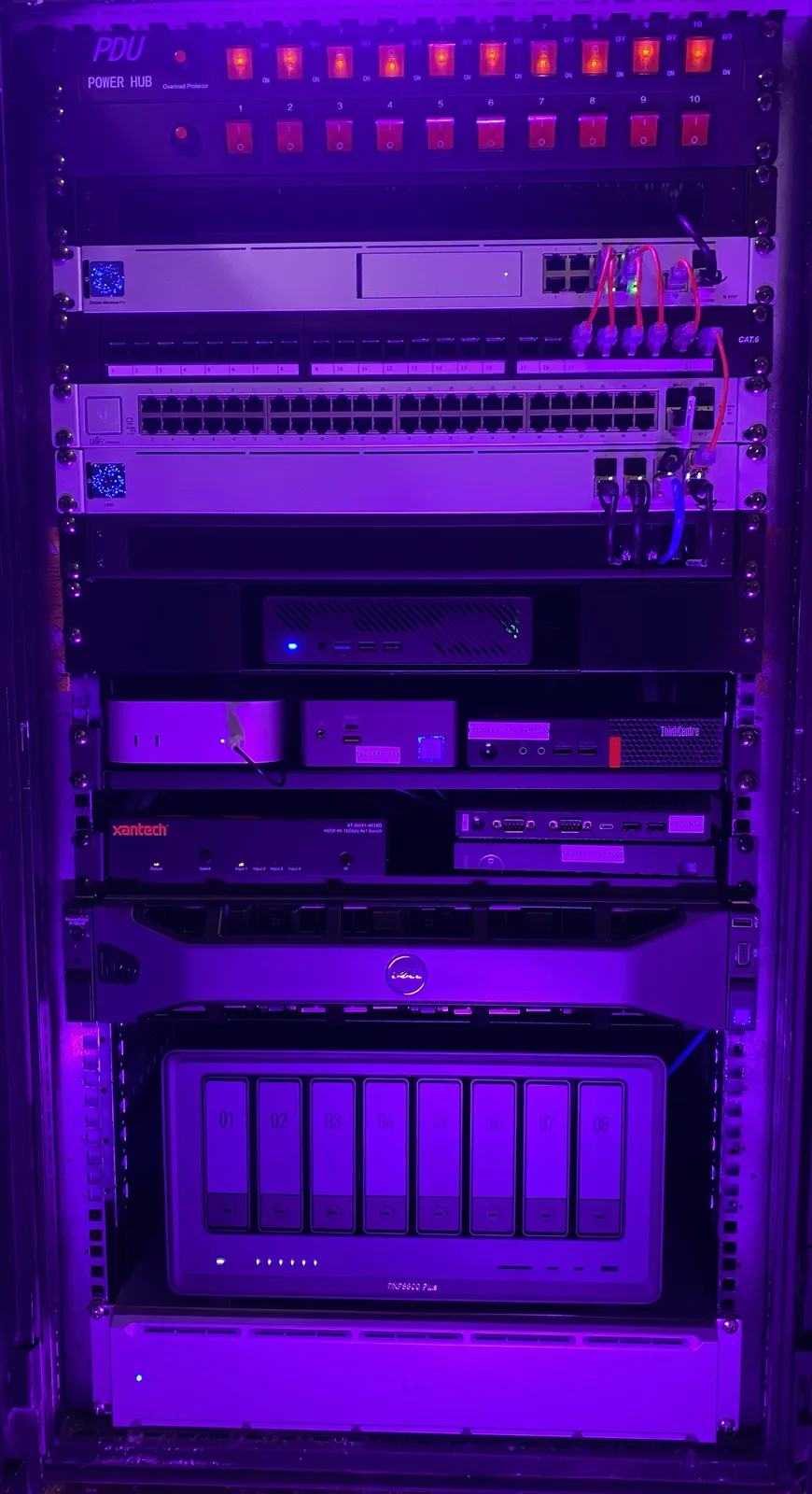
Imogen Labs is the one-person shop I run while I also look for my next corporate role. HomelabARR CE and PE are live. NeuroHelper is in App Store review. Managed hosting and a lineup of AI agent experiments are in progress. An AI operator runs 24/7 behind all of it. Almost all of it (every internal deployment, every email draft, every security review, the AI operator that runs 24/7) lives on a server rack in my parents' house. The one exception is customer-facing production, which runs on a rented Hetzner box. The rack is for development and orchestration, the things that don't take public traffic.
A Mac Mini M4 for AI orchestration. A Minisforum MS-01 with 96GB of RAM as the production workhorse. A UGREEN NAS with 56TB of usable storage. Two Dell R730XD servers. An Intel NUC as a test lab. A UniFi UPS keeping it all alive. The rack carries development, orchestration, internal ops, with no cloud bill, just power and API calls. (Customer-facing production runs on a rented Hetzner dedicated server, covered below; the rack is not where the public traffic lands.)
Most founders would call this reckless. I think it's the most efficient setup I could have built, and the rest of this post lays out why.
The architecture
Here's how it fits together:
{`┌─────────────────────────────────────────────┐
│             Mac Mini M4 (Brain)              │
│  Agent Gateway → Imogen (AI Operator)        │
│  Claude Code dispatcher → project repos      │
│  Cron jobs, memory, logs                     │
└──────────────────┬──────────────────────────┘
         │
         ┌─────────┼─────────┐
         ▼         ▼         ▼
┌──────────────┐ ┌───────┐ ┌──────────────────┐
│ MS-01 (Prod) │ │  NAS  │ │  R730XD x2       │
│ 96GB RAM     │ │ 56TB  │ │  128GB RAM each  │
│ Proxmox      │ │ UGREEN│ │  Arc Pro B50     │
│ Docker       │ │DXP8800│ │  Proxmox/Docker  │
└──────────────┘ └───────┘ └──────────────────┘
         │                          │
         ▼                          ▼
┌──────────────┐           ┌──────────────────┐
│ Intel NUC    │           │  UniFi UPS 2U    │
│ Test Lab     │           │  UDM Pro         │
│ i5, 32GB RAM │           │  Network + Power │
└──────────────┘           └──────────────────┘`}
The Mac Mini is the brain: AI orchestration, development, Imogen's home base. The MS-01 is the production workhorse with 96GB of RAM running Proxmox and Docker. The UGREEN NAS handles bulk storage with 56TB of usable space across eight drives. The Dell R730XDs provide additional compute and GPU acceleration with Intel Arc Pro B50 cards. The Intel NUC is a dedicated test lab where my AI assistant can spin up and destroy Proxmox environments without risking production. Everything sits behind a UniFi network with rack-mounted battery backup.
What Imogen actually does
Imogen is an operator, not a chatbot: a schedule, persistent memory, and real autonomy inside defined boundaries. Here's her daily rhythm:
| Time | Job | What It Does |
|---|---|---|
| 7:00 AM | Morning Briefing | Calendar, email summary, project status, weather |
| 9:00 AM | Self-Improvement | Review instincts, update memory, prune stale references |
| 12:00 PM | Midday Update | News scan, project pulse, blocked work check |
| 6:00 PM | Project Pulse | Git status across all repos, stale branches, open PRs |
| 11:00 PM | Nightly Rundown | What shipped, what's blocked, tomorrow's plan |
| 12:00 AM | Git Sync | Commit and push any uncommitted work across repos |
| 2:00 AM | Security Review | Firewall logs, anomaly detection, LuLu report |
Between these scheduled jobs, she's available on demand via Telegram. I send her a message, she processes it, and either handles it herself or dispatches to Claude Code for implementation.
The AI Roundtable
Mission Control, my ops dashboard, has a feature called the AI Roundtable. When I need to make a decision, I don't just ask one AI. I throw the question to multiple agents at once: a strategist, a skeptic, a technical architect, and a financial analyst. They argue it out and poke holes in each other's reasoning.
The managed hosting product came out of a roundtable session. I asked whether I should focus on SaaS or managed hosting. The strategist said SaaS has better margins. The skeptic said I don't have the runway for a long SaaS sales cycle. The architect said managed hosting lets me reuse infrastructure I already run, while the financial analyst ran the unit economics both ways.
Managed hosting won. I made the call, but only after four agents had argued every angle and the tradeoffs were finally clear.
The hardware stack
| Device | Role | Specs |
|---|---|---|
| Mac Mini M4 | AI orchestration, dev environment | M4, 24GB RAM |
| Minisforum MS-01 | Production server, heavy lifting | 96GB RAM, Proxmox |
| UGREEN DXP8800 Pro | NAS, media, bulk storage | 8x 16TB drives, ~56TB usable |
| Dell R730XD #1 | Docker host, Proxmox VMs | 128GB RAM, Intel Arc Pro B50 |
| Dell R730XD #2 | Storage, backup, media | 128GB RAM, mixed storage array |
| Intel NUC | Test lab, Proxmox sandbox | i5, 32GB RAM |
| UDM Pro | Network gateway, firewall | UniFi ecosystem |
| UniFi UPS 2U | Battery backup | Rack-mounted, keeps everything alive |
The whole compute stack cost less than most startups spend on AWS in a single month. The Dell servers were bought used. The Mac Mini was $589. The MS-01 and NAS were the bigger investments, but even combined the whole rack cost less than a decent used car. The Intel NUC is a dedicated test box my AI assistant uses as a playground to spin up and tear down Proxmox environments without risking anything in production.
Why not just use the cloud?
Because I know exactly what cloud costs look like. I managed roughly a million dollars a month in AWS spend at my last job. I watched teams spin up instances they forgot about, run dev environments 24/7, and pay hyperscaler markup on storage that could have lived on a $200 hard drive.
For my use case (AI orchestration, development, CI/CD, monitoring) the Mac Mini does everything I need. The API calls to Claude are the real cost, and those are the same whether I'm running from a cloud instance or my living room. So I keep the compute cost near zero and put the budget where the actual value is.
When I need to scale, I go to Hetzner bare metal, not AWS. A dedicated server with 128GB RAM costs $89/month on Hetzner and roughly $900/month on AWS. I know that math because I used to manage it.
The single point of failure question
The Mac Mini is the only single point of failure that matters. If it dies, Imogen stops running, cron jobs stop firing, and I lose my AI operator until I replace it. The production workloads on the MS-01 and Dells would keep running. They do not depend on the Mac Mini to serve traffic.
I'm okay with that right now. Here's why:
- Customer-facing products are deployed to Hetzner, not to the rack. The rack is for development and orchestration.
- All code is in git. All memory is on disk with backups. Nothing is lost if the Mac Mini dies. I just lose the operator temporarily.
- Replacing a Mac Mini takes 24 hours. Replacing a cloud region takes longer and costs more.
- The UPS keeps everything alive through power flickers. The real risk is hardware failure, and at my current scale that risk is acceptable.
What this means
A software company at my scale doesn't need a cloud bill, a DevOps team, or Kubernetes. It needs a machine that runs reliably, an AI that handles the repetitive work, and a human who makes the judgment calls.
I have all three. The machine cost $589, the AI runs about $200/month in API calls, and the human is me, who works for equity.
Add it up and that's the entire operating cost of everything I'm building.