November 20, 2026
HomelabARR now counts who uses it
HomelabARR 2.6.8 sends anonymous usage data by default with a one-line off switch, and the same day Eight.ly OS learned to rebuild a disk that comes back with the same serial.
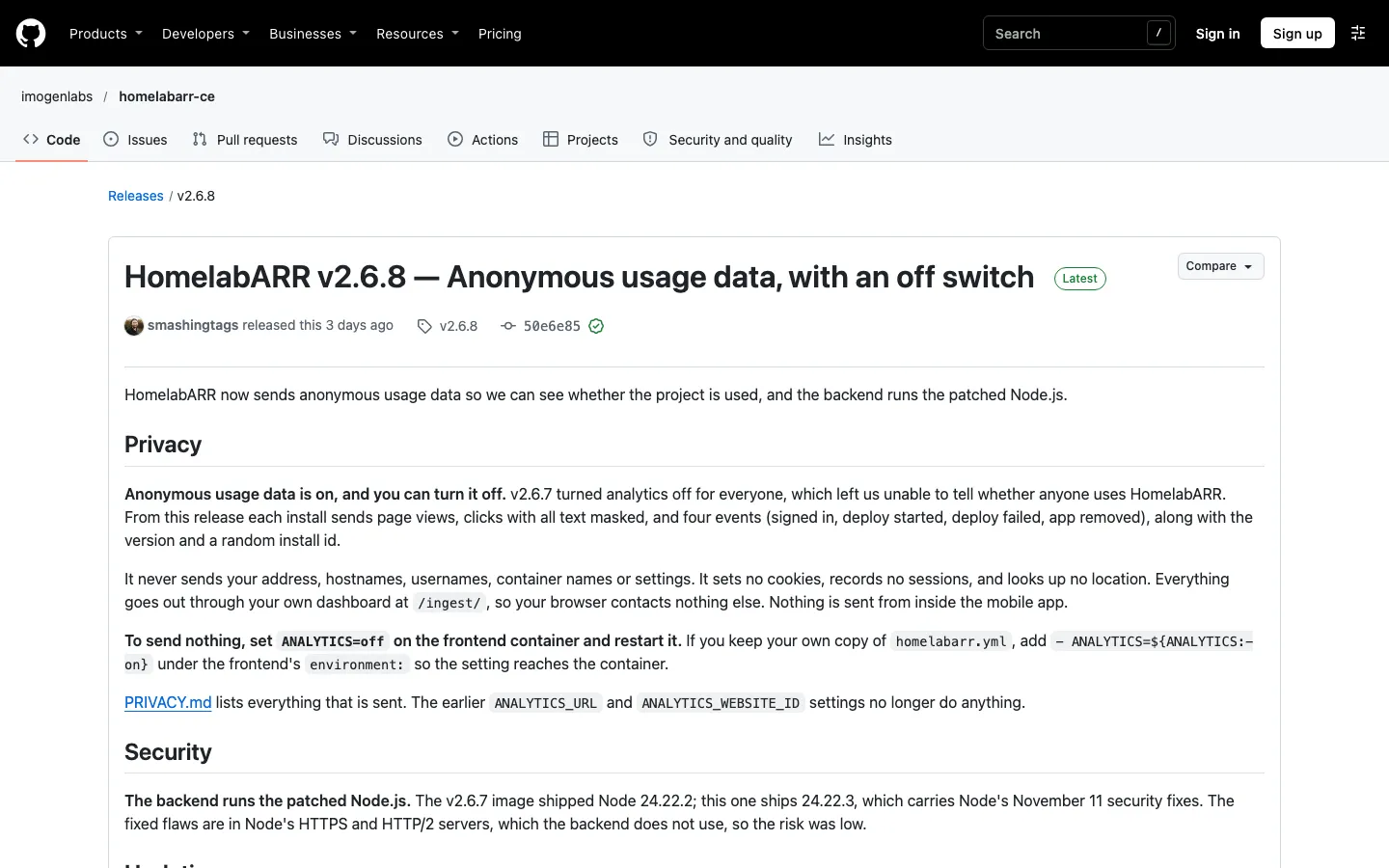
On November 20 I released HomelabARR 2.6.8, and the headline of its notes is a decision about data. HomelabARR now sends anonymous usage data by default, and you can turn it off with one setting.
What it sends and what it does not
The release before it, 2.6.7, had turned analytics off for everyone. That was the safe choice, and it left me unable to tell whether anyone uses HomelabARR at all. Version 2.6.8 sends page views, clicks with all text masked, and four events: signed in, deploy started, deploy failed and app removed. Each install adds its version and a random install id. It never sends your address, hostnames, usernames, container names or settings. It sets no cookies, records no sessions and looks up no location.
Everything goes out through your own dashboard at a path called ingest, so your browser contacts nothing else. To send nothing, set ANALYTICS=off on the frontend container and restart it. The privacy file in the repository lists everything that is sent, and the page on homelabarr.com now says the same. The mobile app sends nothing, which keeps its App Store label honest.
The reports go into the same PostHog project that MemIndex uses, since the plan allows one, and every HomelabARR event carries a product property so the charts can tell the two apart. I also turned on discarding of client IP data for the whole project. I built an installs dashboard that counts installs per day, by version, and demo visitors separately. Release 2.6.8 also moves the backend image to Node 24.22.3, which carries the November 11 security fixes, though the flaws were in HTTPS and HTTP/2 servers the backend does not use. Continuous integration now records Docker Hub pull counts every day, and I dropped a compiled Python file that had been committed by mistake.
Rebuilding a disk onto itself
On the Eight.ly OS side, the change I cared most about merged early that day. In soak phase 3, a data disk dropped out of the 8RAID array and came back with the same serial. Replace answered with a 500, left the driver unloaded, kept the changed pool record and never restarted the guests it had stopped. A later start then reported the pool blocked although it was up, and a retry was refused.
I measured the driver rather than guess. On driver version 2.9.40, a disabled slot that still has its saved identity, given the same disk again, simply starts with no rebuild. The driver offers the rebuild only after one start with that slot empty. This is what Unraid calls rebuilding a disk onto itself, so I copied it: a returned disk now goes through one start with the slot empty, a stop and an import, and then rebuilds. A replace sends start only when the driver reports a rebuild for every target. The changed pool record is written only once the driver accepts, and a refused or failed replace restores it byte for byte, restarts the pool degraded, and restarts the guests and shares that were stopped for the change.
I proved it on a test VM, starting from the stuck state the soak had left: the pool came up started and degraded by itself, the pending rebuild cleared, the guest restarted, and 8 of 8 checksums matched. Then I pulled a disk while the pool was started, returned it, replaced it, and watched the rebuild finish healthy.
The rest of Eight.ly OS
Several smaller merges came in. A user signed in with a temporary password used to get the whole dashboard with every call refused and nothing to set a new password with. The sign-in gate now shows a full-screen change-password form, and the server refuses an empty new password, which used to clear the lock while the temporary one stayed valid. Release candidates now sort before their release in the update check, so rc.5 counts as newer than rc.3, and the image blocks the SCTP kernel module. The container monitor samples every 30 seconds, and CI retries the flaky frontend tests.
Late that day the first of the Unraid-style data protection fixes merged. A box that boots from a stick and keeps its settings there saves a plain zip of the settings folder every day to a pool, never to the stick, and you can download a copy of the whole stick. Drive temperature alerts now use Unraid's defaults, 45 and 55 for hard drives, 60 and 70 for SSDs, with NVMe judged by its own limits. Cable-error counts warn at the first value above zero and on every rise, and a sleeping disk is never woken to check.
The storage label went onto six more CI runners, so image builds run in parallel across seven runners and not queue behind one. I ran four draft builds at once to prove it.
MemIndex and the smaller releases
MemIndex hosting went live on a rebuild that takes its server from the MemIndex repo with no copy, at about four in the afternoon. In the evening I took a code review and turned each finding into a test that reproduced it before any fix: cloud sync no longer loses data after a snapshot restore, queued jobs are reconciled after an outage, summary jobs survive a worker crash, and a release now requires green tests and a green Windows run on the exact commit. A batch of 45 server fixes merged that evening and went to hosting after a backup. I also added the Codex sign-in as a quota fallback for note writing.
Eight.ly Agent 2.1.1 is built with Go 1.26.11, which closes a net/http vulnerability, and its README was shortened with an upgrade guide and a connect walkthrough added. The backup server's 0.1.13 pins its packaging tool to the newest version that builds on Go 1.26 and raises dependencies to close reported vulnerabilities.