March 17, 2026
Why I'm launching managed AI agent hosting
Hetzner bare metal, 90% margins, and an AI roundtable that told me to do it. The math behind managed OpenClaw hosting.
The problem
Running an AI agent in production is harder than running the AI. The model part keeps getting easier every month. The infrastructure part doesn't. You need a server that stays on. You need process management so the agent comes back when it crashes. You need monitoring so you find out before your users do. You need backups for the memory and state the agent accumulates, because that's the part you can't regenerate. And you need somewhere to put API keys that isn't a plaintext file on a box you forgot to firewall.
Most people who want an agent running 24/7 don't want to run a server to get it. They want to deploy it and stop thinking about it. The uptime, the updates, the 3 AM page when the cron job wedges: that's the work they're trying to avoid, and it's exactly the work I already do for myself every day.
The roundtable decision
I didn't make this call alone. I put the question to Mission Control's AI Roundtable, which is four agents I run with deliberately different priorities, arguing it out.
The Strategist wanted SaaS. Build a platform, charge per seat, scale horizontally, pitch the multiple to investors. The Skeptic killed it in one line: I don't have runway for a 12-month SaaS sales cycle, I need revenue in 30 days. The Architect pointed out the obvious thing I'd been circling: managed hosting reuses the exact stack I already run for Imogen. Same OpenClaw setup, same monitoring, same deploy patterns. The marginal cost of one more customer is a Hetzner box and an afternoon of configuration. The Financial Analyst ran the unit economics both ways and managed hosting won on every line.
It's a useful exercise precisely because the agents don't agree with each other, and they don't agree with me by default. The Skeptic exists to tell me no.
The math
Here's why managed hosting on Hetzner bare metal pencils out:
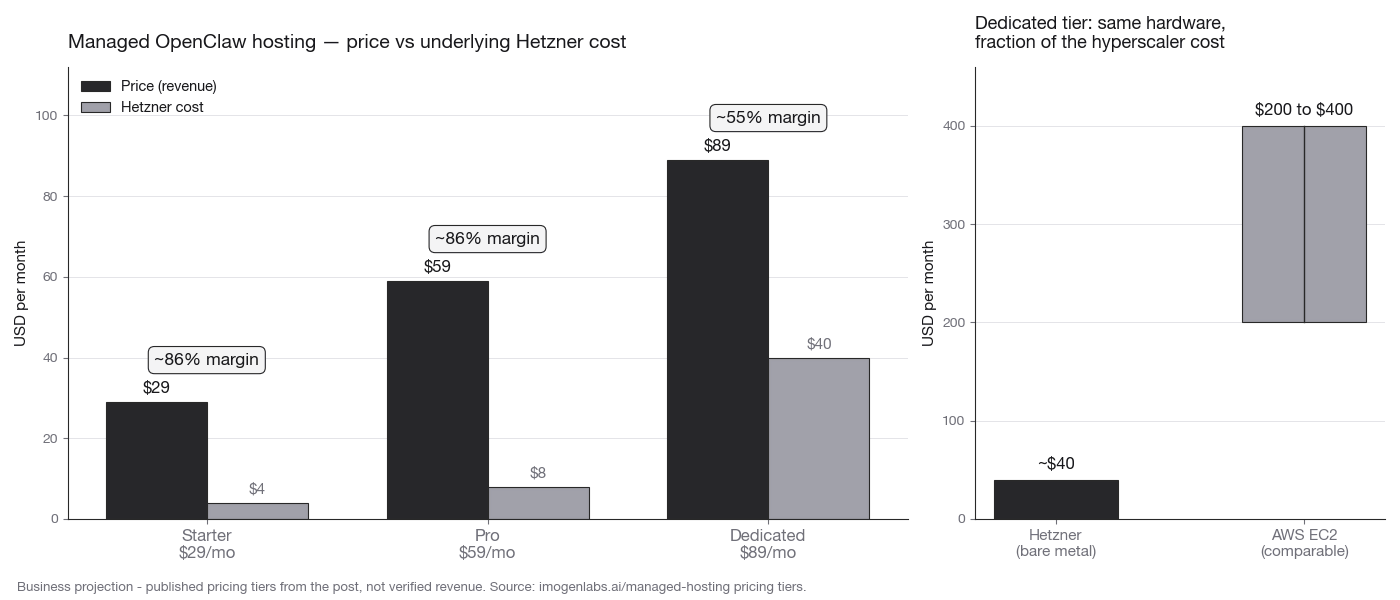
| Tier | Price | Hetzner Cost | Margin |
|---|---|---|---|
| Starter | $29/mo | ~$4/mo (shared) | ~86% |
| Pro | $59/mo | ~$8/mo (shared) | ~86% |
| Dedicated | $89/mo | ~$40/mo (bare metal) | ~55% |
Compare that to AWS. A comparable EC2 instance for the Dedicated tier runs $200 to $400 a month. Hetzner gives you the same hardware, often better, for a fraction of it. That gap is the whole business model, not a footnote to it.
I know these numbers because I used to manage roughly a million dollars a month in AWS spend, and I read the invoices. I know where the markup lives and what it's paying for. Hetzner cuts infrastructure cost by 70 to 80 percent against the hyperscalers, I pass some of that to the customer, and I keep margins that fund the business instead of begging for the next round.
What you get
Every tier includes:
- OpenClaw pre-installed and configured. The agent gateway is up and wired on day one, not waiting on you to read a README.
- operator-kit scaffolding. Identity, memory, the instincts engine, agent roles: the same pattern Imogen runs on, dropped on top of OpenClaw for you.
- Monitoring and alerting. I find out your agent is down before you do.
- Daily backups. Memory, state, and configuration. The stuff your agent has learned that you can't get back.
- Telegram and webhook notifications. Your agent reaches you the same way Imogen reaches me.
- SSH access. It's your server. I manage it, you own it.
The Dedicated tier swaps shared infrastructure for bare metal: no virtualization overhead, no noisy neighbors, dedicated CPU and RAM.
A note on honesty, because it matters to me. I didn't write OpenClaw. It's an open agent gateway I run and extend, and what I'm selling is the operational layer around it plus operator-kit, which I did write. I'd rather you know that than buy on a claim I can't back.
Why me
I'm not selling a box. I'm selling the operational knowledge that comes from running this exact stack in production every single day. Imogen runs on OpenClaw. My company runs on Imogen. When something breaks in this ecosystem, it breaks my operations first, so I'm usually already a few hours into the fix before anyone else has noticed.
I'm also the one writing operator-kit, the library that stands up the agent infrastructure. Ask me about agent memory, the instincts engine, or multi-agent dispatch and you're talking to the person who built that part, not a support tier reading a script.
So the marginal effort to manage your OpenClaw instance is genuinely small, because I'm already managing my own. The tooling exists. The monitoring exists. The 3 AM muscle memory exists. I'm making it available.
The bet
AI agents are going from novelty to infrastructure. Websites made that same trip from "cute experiment" to "every business needs one," and agents are partway through the same one now. When they land, someone has to host them, manage them, and be awake at 3 AM when the cron job fails and the memory store fills up and the API key rotates out from under it.
I'm betting that someone is me, on Hetzner bare metal, with margins that don't need venture capital to survive. Twenty customers at $59 a month is about $14,000 a year in revenue against roughly $1,900 in infrastructure cost. That's not a unicorn, and I'm fine with that. It's a business that pays for itself in month one and doesn't owe anybody a 100x exit.