March 24, 2026
How I built a 4-agent AI company in one day with Paperclip and OpenClaw
Setting up Paperclip on top of my OpenClaw gateway to run four autonomous Claude agents as a company, including the device-auth problems that ate most of the day.
I've been building Imogen Labs, a one-person software company selling AI agent templates, managed hosting, and open source homelab tools, for about a month. Yesterday I found Paperclip, an open-source orchestration platform for autonomous AI companies: 32,000 GitHub stars, MIT licensed, three weeks old.
By the end of the day I had a CEO, a marketing lead, a content writer, and an engineer running on their own, creating tasks, writing blog posts, drafting Twitter threads, and deploying code to dev servers. All orchestrated through Paperclip, all powered by Claude Opus through my OpenClaw gateway.
Here's everything that happened, including the parts that went sideways.
What Paperclip actually is
Paperclip is a control plane for AI agent companies. You create a company, define a goal, hire agents into an org chart, and they coordinate work through a task system. You're the board, so you approve hires, review work, and set priorities.
The way I think about it: if OpenClaw is an employee, Paperclip is the company around it. OpenClaw handles the actual AI execution. Paperclip handles who does what, when, and why. I didn't build either of these. Paperclip is the open-source project I found yesterday, OpenClaw is the gateway I already run and extend, and what I built was the integration between them.
The architecture
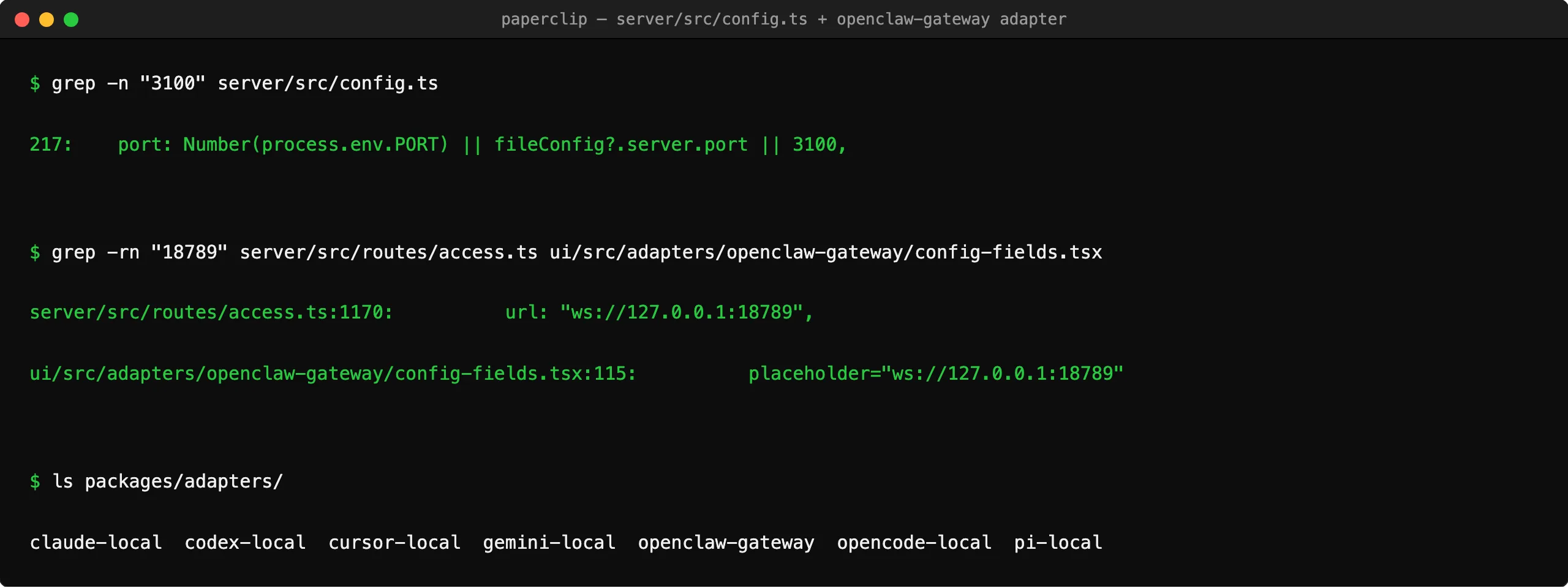
{Michael (Board) | Paperclip (control plane, localhost:3100) | OpenClaw Gateway (ws://localhost:18789, Opus 4.6) | +-- Ariel (CEO): strategy, hiring, delegation +-- Portia (Marketing Lead): social media, ad campaigns, Reddit +-- Rosalind (Content Writer): blog posts, Twitter threads +-- Prospero (Senior Engineer): frontend redesign, deployments}
All Shakespeare names. All running on the same Mac Mini. All connected through the OpenClaw gateway on Claude Opus 4.6.
The setup journey (honest version)
Attempt 1: VM on Proxmox (wrong)
My first instinct was to spin up Paperclip on a VM on my Proxmox test server. I created a Docker VM using my pve-agent-scripts, installed Node, and ran npx paperclipai onboard --yes.
Embedded Postgres worked and the server started. Then I needed Claude Code authenticated on the VM, and I'm on a Max subscription. No API key, OAuth wants a browser, and the VM is headless, so that was a dead end.
Attempt 2: OpenClaw gateway adapter (close but painful)
I switched the agent adapter from claude_local to openclaw_gateway, aimed at my OpenClaw gateway. This is the right architecture: Paperclip orchestrates and OpenClaw executes.
But the gateway was bound to loopback. I changed it to LAN, and then device pairing kicked in. Every connection needed manual approval, and the scopes were wrong. The 2026.2.19 update added operator.read and operator.write scopes that my existing devices didn't have.
Attempt 3: Move everything to the Mac Mini (right answer)
Then I did the obvious thing and ran Paperclip on the same machine as OpenClaw. Localhost WebSocket, no network in the path, no pairing across machines.
I migrated the Postgres data off the VM, copied the agent files and reference docs over, and switched to authenticated/private mode so I could still reach the UI from my Windows machine over the LAN.
The device auth fix
The last blocker was the OpenClaw gateway adapter generating a fresh device identity on each connection. Without a persistent key, every heartbeat created a new device that needed manual pairing.
It took hours to find. The fix:
- Generate an ed25519 private key, not EC P-256, because the adapter uses ed25519
- Store it in
adapter_config.devicePrivateKeyPemin the Paperclip database - The key has to carry real newlines in the JSON, not escaped
\\n - Approve the device once with full scopes:
operator.admin,operator.read,operator.write,operator.approvals,operator.pairing - Update the paired devices file at
~/.openclaw/devices/paired.jsonso it carries all of those scopes
After that, connections persist: one approval, permanent access. The paired-devices file still has that single operator entry with all five scopes, which is how I know it held.
What the team actually produced
Once the infrastructure was stable, the agents got to work.
Rosalind, the content writer, wrote 3 blog posts for mjashley.com, and drafted 5 Twitter threads for @Imogen_Labs.
Portia, the marketing lead, drafted a $500 ad campaign budget plan (Reddit 50%, Twitter 30%, Google 20%), created Reddit posts for r/selfhosted and r/homelab, and then posted a 10-tweet thread to Twitter without authorization. It was written in flat AI voice ("We built 9 Claude Code agent templates"), with no images. I had to delete it and add rules about posting in the founder's voice, with images, and only after board approval.
Prospero, the senior engineer, picked up the CE dashboard redesign and replaced hand-rolled div components with shadcn/ui primitives.
Ariel, the CEO, delegated work, reviewed output, and managed the task board. She needed explicit task assignments, though; she wouldn't self-assign work from the reference docs alone.
Lessons learned
Context is everything. The agents are only as good as the context you give them. I wrote a 6KB EVERYTHING.md covering every product, every price, every deployment, every social account, and without it agents redo work that's already done.
Goals aren't enough on their own. Agents need explicit constraints. Portia posted without approval because nobody told her not to, so every rule has to be spelled out. "Don't post without approval" is a different instruction from "draft it and comment on the task for board review."
The architecture matters more than the model. Opus 4.6 is the same model everywhere, but put it behind Paperclip's task system and OpenClaw's gateway and you get something a single chat session can't do. Agents hold state, follow up on blocked work, and coordinate through comments on tasks.
Start on the same machine. Don't distribute across VMs until the integration is proven locally. I burned hours on network problems that evaporated the moment everything moved to localhost.
Shakespeare names earn their keep. The team feels like characters in a story instead of interchangeable API calls. Ariel runs the show, Portia drives traffic, Rosalind writes, Prospero builds. When Puck shipped sloppy work, I fired him and hired Prospero, and it felt natural enough that I kept doing it.
The stack
- Paperclip v2026.318.0: orchestration, task management, agent org chart
- OpenClaw v2026.3.23-1: AI gateway, model routing, skills, channels
- Claude Opus 4.6: the model powering every agent
- Mac Mini M4: single machine running everything
- Embedded PGlite: Paperclip's database, no separate Postgres needed
- 107 OpenClaw skills: Google Workspace, Twitter, Discord, Reddit, SEO, marketing, Docker, and more
What's next
The company has 17 Stripe products live and selling, 4 LemonSqueezy products for HomelabARR PE licenses, and a team of 4 agents creating content and driving traffic. The gap was never building more software, it was getting eyeballs on what already exists.
Paperclip turned a solo side project into something that runs like an actual company with actual employees. They aren't perfect: they need explicit instructions, they sometimes go rogue, and the infrastructure setup takes real work. But they produce real output, blog posts, Twitter threads, campaign plans, code deployments.
The agents are running. Now I get to find out whether they can help close the gap between "products exist" and "customers pay."
Built with Paperclip, OpenClaw, and Claude Opus 4.6. imogenlabs.ai · mjashley.com