November 17, 2026
Parity that says what it is doing
The Eight.ly OS dashboard now names every long job with its progress, ZFS pools from a classic install mount on the image, and MemIndex turned on opt-out usage reporting.
A parity scrub on a big array runs for hours, and until November 17 the dashboard could not tell you whether one was running. The array card said "could not be checked" whenever the status call failed during a run, which is exactly when you want to know the run is still going. The first merge of the day, at 8 in the morning, fixes that and a few things around it.
What the array card says now
While a scrub runs, the array card shows it with a percentage, a speed and the time left. If the status cannot be read during a scrub or sync, the card shows the last good result with its date instead of the bare error. Parity events now say whether they were a sync or a scrub and when each one finished. A smaller fix sits next to it: ordinary file changes no longer mark parity as out of date.
The dashboard also opens with a strip that names every long job on the box. That covers scrubs, syncs, parity checks, balances, Shelver runs, backups, SMART tests, disk preparation and updates, each with percent, speed and time left, updating live. When nothing is running the strip is not there. A job whose progress cannot be read still shows its name and when it started, and a running job is mentioned once on the dashboard, not three times in three cards. I wrote a failing test for each of those behaviours before the change.
Classic ZFS pools on the image
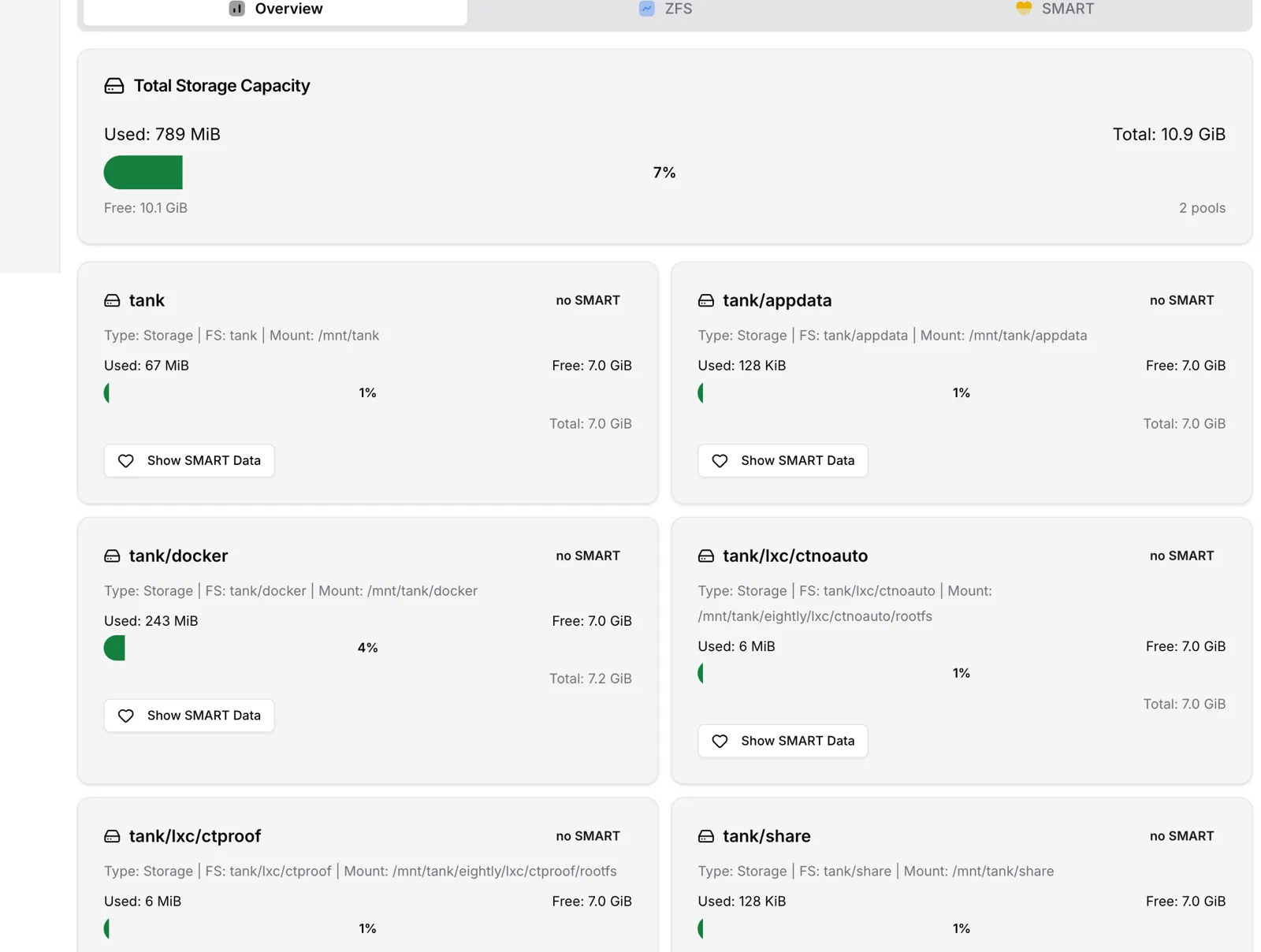
The other large merge came in the afternoon. A box that currently runs the classic install, with ZFS pools such as one called tank mounted at its own path, has to be able to move onto the read-only image and, if I need to, back. On the image, the pool is now imported under /mnt, with no cache file, and it comes back after a reboot before libvirt, LXC and Docker start. The classic install can still import it afterwards without forcing.
Two details took the most care. The image adopts the classic install's ZFS host id, because it is the same machine, saves it, and re-stamps its own pools, so no boot needs a forced import. And one dataset that fails to mount no longer fails the whole pool, and one missing pool no longer stops the workloads that live on the others. The first click on Import now works as well; before, two scans running at once could trip over each other, and the scans are queued one at a time. A restored settings backup points VMs, LXC guests, app data and shares at the pool's new place and recreates the LXC guests, and running it twice changes nothing.
I proved it on a test VM the day before, in the order a real box will go through it, with power cuts on both sides, and all fifteen criteria passed. That mattered because a boot-path change cannot be judged by tests that never boot.
The notes for the third release candidate were merged that morning. In the evening I fixed the layout gate in CI so it counts text lines instead of padding, and at 8:16 I cut the rc.3 tag.
MemIndex 1.7.2 and 1.7.3
MemIndex 1.7.2 shipped in the afternoon. Anonymous usage reporting is now on by default, with one notice during install. It never sends notes, prompts or code. It turns off with npx memindex telemetry disable, with DO_NOT_TRACK=1, or with MEMINDEX_TELEMETRY=off. The reports go to PostHog, which replaced the analytics I had on memindex.ai, and the site is cookieless. The PostHog plan allows one project, so the product and the site share it. The privacy page and seven docs pages now say reporting is on by default.
Version 1.7.2 also fixed a quieter problem with Codex. Every MemIndex release changes the hook files, and Codex marks changed hooks as modified and skips them silently. Setup and updates now offer to trust MemIndex's hooks. The same release updated hono for five security fixes, and the Jira import and Cloud Sync setup now show you how to connect.
Version 1.7.3 came in the evening and fixed something I could measure. Search by meaning stayed off after an install or update because the worker started from a folder that had no libraries. The marketplace copy had no node_modules at all. Worker launchers now prefer an installed folder that has its libraries, and Codex hook trust now works on Windows when Codex came through WinGet.
The rest of MemIndex
The README now lists every skill with what it does and links every command to its docs page, and docs-only changes skip the full CI run. The site's hero leads with memory across agents, machines and teammates, with wording that says it helps recall rather than guaranteeing it. I wrote docs for connecting Jira before an import and a page for every slash command. In the cloud repo I bumped hono to 4.13.18 for the same security fixes.
The big upstream pull started that evening. The project MemIndex began from had accumulated several hundred fixes, and I started bringing them in one commit per fix, so any single one can be reverted alone.