March 22, 2026
I ripped out a Docker plugin nobody needed
77 Docker Compose templates. Every one had a third-party volume plugin dependency. I replaced them all with native Docker bind mounts in one afternoon.
Every app template in HomelabARR CE carried a dependency I never put there. It sat at the bottom of every YAML file, and most people never read that far, so nobody noticed it until a deploy failed on a clean box.
77 Docker Compose templates. Every single one ended with this:
volumes:
  unionfs:
    driver: local-persist
    driver_opts:
      mountpoint: /mnt
local-persist is a third-party Docker volume plugin. It is not part of Docker. If it is not installed on the host, Docker cannot create the unionfs volume, so the container never starts. Plex, Sonarr, Radarr, qBittorrent, every media app in the catalog hits the same wall, and the failure is quiet because the volume creation is what breaks, not the app.
Where the plugin came from
This is inherited code. HomelabARR CE descends from the dockserver era, and back then the storage model was different. The array was Google Drive mounted through rclone, merged with local disk through mergerfs. The effective mount point could move depending on what was mounted and when. A named volume backed by a plugin was a reasonable answer to a path that was not stable.
That was a 2019 problem. In 2026 most people running this are pointing at a local NAS, the array lives at /mnt, and it does not move. The plugin was solving a problem the current users do not have, and charging them an install step to do it.
A plain Docker bind mount does the same job with nothing to install:
volumes:
  unionfs:
    driver: local
    driver_opts:
      type: none
      o: bind
      device: /mnt
driver: local is built into Docker. The type: none, o: bind options tell it to bind the host path straight through. Same /mnt inside the container, same unionfs name so nothing referencing the volume has to change, zero plugins.
The conversion
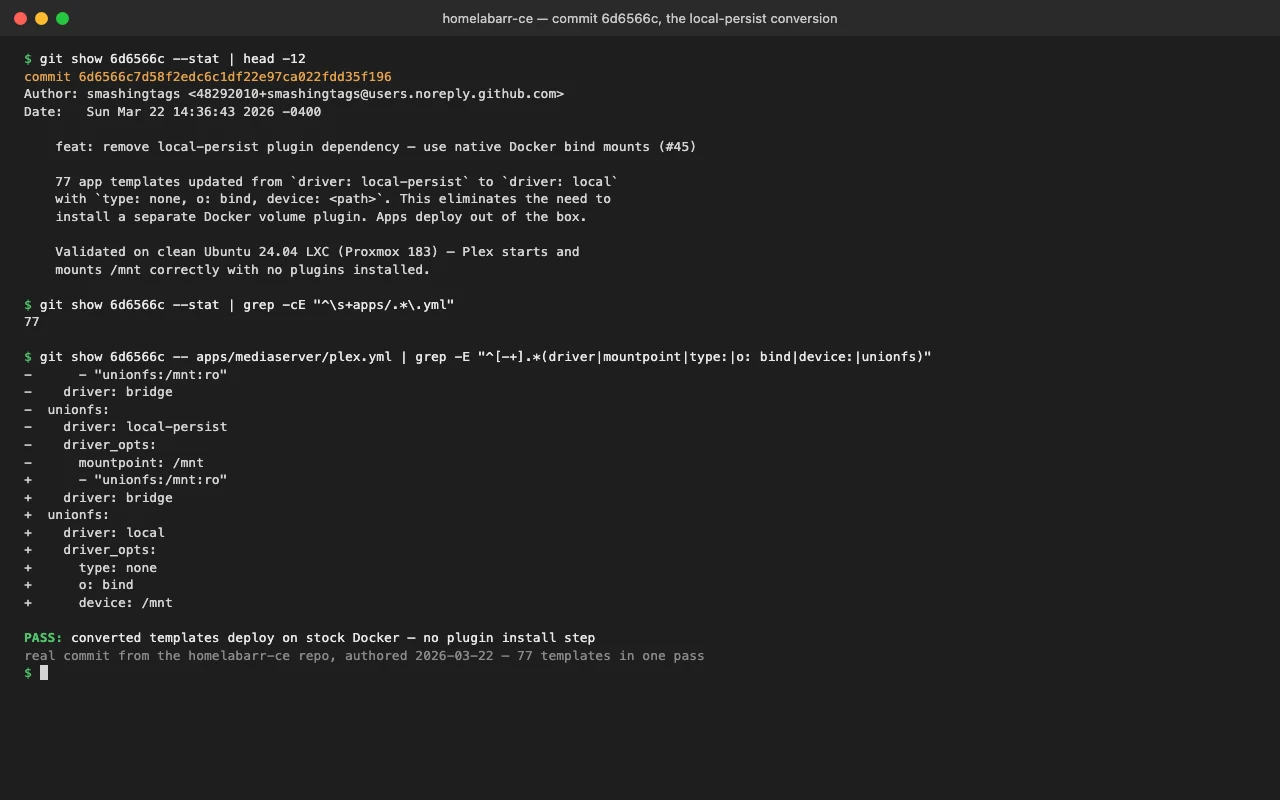
It was a mechanical change repeated 77 times. The same local-persist block in apps/mediaserver/plex.yml:
# BEFORE — apps/mediaserver/plex.yml
volumes:
  unionfs:
    driver: local-persist
    driver_opts:
      mountpoint: /mnt
# AFTER
volumes:
  unionfs:
    driver: local
    driver_opts:
      type: none
      o: bind
      device: /mnt
The identical block lived in apps/mediamanager/sonarr.yml, radarr.yml, the download clients, the addons, the config samples. All 77 got the same treatment in one pass, plus the wiki nav and references that still pointed at the plugin. That landed in 6d6566c.
Proving it on a clean box
The whole point of this change is that a new user does not have the plugin installed, so I tested as a new user would land: a fresh Ubuntu 24.04 LXC on Proxmox with nothing extra on it. Deployed Plex from the converted template. It started, mounted /mnt, and ran, with no plugin anywhere on the host. That validation is recorded in the 6d6566c commit, not a separate test log.
What inheriting a codebase teaches you
This is the kind of thing you only find by actually running the project the way a stranger would. The plugin made sense on the maintainer's machine because they installed it three years ago and stopped seeing it. It made sense for the storage model the project was born with. It stopped making sense the moment the storage model changed, and nobody went back to check, because it kept working for the people who already had it.
77 files converted in one pass. The catalog now deploys on stock Docker with no setup step, which is what it should have been doing all along.