March 8, 2026
The gap wasn't nothing
Five months of a gray contribution graph that looked like I quit, and what the gap actually was: hardware, healing, and a DGX Spark I camped out for and returned.
If you look at my GitHub contribution graph from mid-September 2025 through February 2026, it is almost entirely gray. Five months of near-zero commits. To anyone tracking my progress, it looks like I quit.
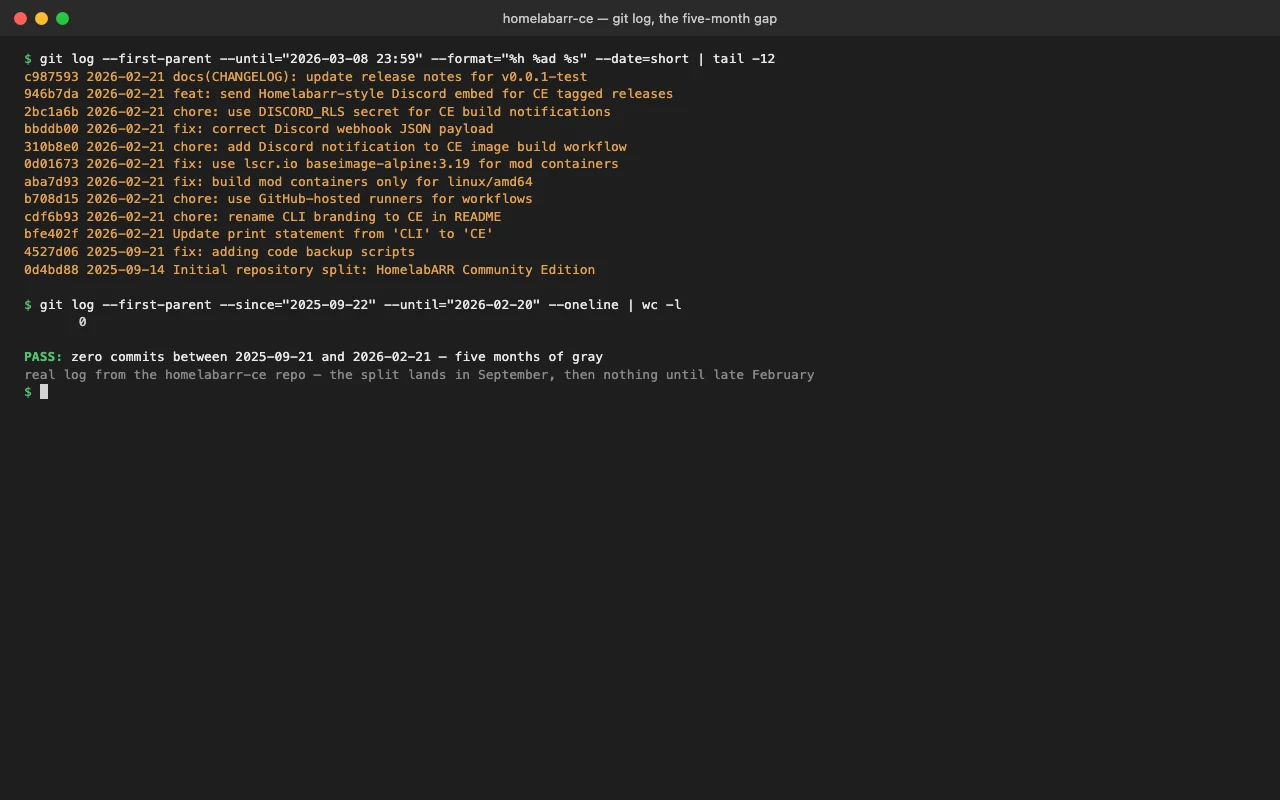
I did not quit. I could not make myself sit down and write code. I needed time to recover after everything that happened, which I've written about elsewhere: the layoff and the divorce.
But there is another part of the gap I haven't talked about: the part where I kept buying hardware.
The receipts
In October I bought two Intel Arc Pro B50 workstation GPUs. $365.94 each. They're compute cards for professional workloads, not gaming hardware. I bought them for the Dell R730XD servers sitting in my parents' living room, because I knew that when I came back to building I'd need GPU compute for AI inference and transcoding.
The same month I ordered a custom single-slot cooler from N3RDWARE in Europe so I could fit one of the Arc Pros into a Minisforum MS-01 mini server. Most people don't even know you can do that. I didn't need it yet, but I knew I would.
In November I bought two UniFi UPS 2U units from Ubiquiti. $279 each, $674.69 total with tax and shipping. Enterprise-grade uninterruptible power supplies for a homelab in a guest room. A few weeks later I sold one on eBay for $450 once I realized I only needed one, $113 profit on the flip.
In February I bought two Western Digital 2TB NVMe drives for $449.26 total, about $225 each. Since then prices have climbed as AI hardware demand drives up NVMe costs. They're still unopened on a shelf, worth more than I paid because the price was right and I knew I'd need them eventually.
The DGX Spark
And then there was the NVIDIA DGX Spark.
$3,999.99 plus $240 tax. $4,239.99 total. A personal AI supercomputer with 128GB of unified memory and a Grace Blackwell chip. NVIDIA's first product aimed at individual developers instead of data centers.
I was at Micro Center in Duluth, Georgia two hours before they opened. I stood outside like it was a console launch. I am a 43-year-old single dad living with his parents and I was camping outside an electronics store at 8 AM on a weekday because I could not help myself.
I bought it, took it home, set it up. Ran benchmarks, tested local AI inference. I felt like a kid on Christmas morning. For a couple of weeks I had a machine on my desk that most AI startups could not afford.
Then I looked at my savings account and returned it right before the window closed. $4,239.99 back on the card. That is the decision a single dad with dwindling savings and no income has to make, even when every enthusiast bone in his body is screaming to keep it.
I do not regret buying it and I do not regret returning it. I got to hold it, use it, and find out what it felt like to run a real AI workstation. That knowledge is worth something even with the hardware off my shelf.
What the gap actually was
Here is what five months of "nothing" actually looked like:
- Two workstation GPUs for future AI compute ($731.88)
- A custom European cooler to fit one into a mini server (€135.23)
- Two enterprise UPS units, one flipped for profit ($224.69 net after the flip)
- Two NVMe drives now worth more than I paid ($449.26)
- An NVIDIA DGX Spark I camped out for, used for a couple of weeks, and returned ($0 net)
- Being a dad
Net hardware spend after returns and flips: about $1,541. Current value of what I kept is more than that. And I came out the other side ready to build again.