March 20, 2026
TrueNAS closed source and what it means for home NAS
iXsystems closed their build system and announced monetization for the community edition, and I lay out why Eight.ly's MergerFS plus SnapRAID stack is not exposed to that risk.
Three weeks ago, iXsystems (now doing business as TrueNAS) closed the source code to their build system. Last week they announced monetization plans for the community edition. The self-hosting community is upset, and I think they have a point.
We have seen this before. HashiCorp did it. Redis did it. Elasticsearch did it. Take an open-source project that built its reputation on openness, grow a large community, then start closing the source once the commercial moat is established.
I am not here to pile on iXsystems. Running a company is hard and they have to make money somehow. But I want to talk about what this actually means for the people who built on top of TrueNAS.
The HexOS problem
HexOS is a product I have watched closely. It is built by Eshtek Inc., it has backing from Linus Sebastian of Linus Tech Tips, and it is genuinely well designed. Their pitch is a friendly, polished UI layer on top of TrueNAS SCALE, the "Powered by TrueNAS" program.
The problem is that "Powered by TrueNAS" now means "our business runs on a closed-source foundation we do not control."
This was already causing problems before the closure. From their own November 2025 roadmap: "VMs were delayed last year due to significant changes within TrueNAS SCALE that made ongoing development challenging." TrueNAS changed their internal APIs and HexOS got burned. And that was with open-source code they could at least read and understand. Now imagine debugging against a closed binary you cannot inspect.
AnyRaid
HexOS also sponsored a genuinely exciting engineering project called ZFS AnyRaid. They hired Klara Inc. to build a new ZFS VDEV type that allows mixed-drive pooling, so you can put drives of different sizes in a pool without wasting capacity.
This was the feature I was watching. Mixed-drive support is the core limitation of ZFS for home users, and AnyRaid was a real solution. Klara presented the work at the OpenZFS Developer Summit and the architecture is solid.
But as of November 2025 it still was not shipped to users. They were still implementing data rebalance. And now the project that funded and drove that work sits on a closed-source foundation.
Whether AnyRaid eventually gets contributed upstream to OpenZFS is an open question. I hope it does, because it is good work. But it is no longer on a clear path.
What the community is actually looking for
The people who chose TrueNAS chose it because it was open. That was the value proposition. Enterprise features, enterprise reliability, open source. If you wanted closed-source NAS software you would buy Synology or QNAP.
Those people are now looking for somewhere to go, and the Reddit threads are full of them.
What they need is software that handles mixed drives: their existing hardware, bought over years, in different sizes. Software that does not require matched drives or enterprise budgets. Software that is actually open source and lets them install whatever apps they want.
Our position
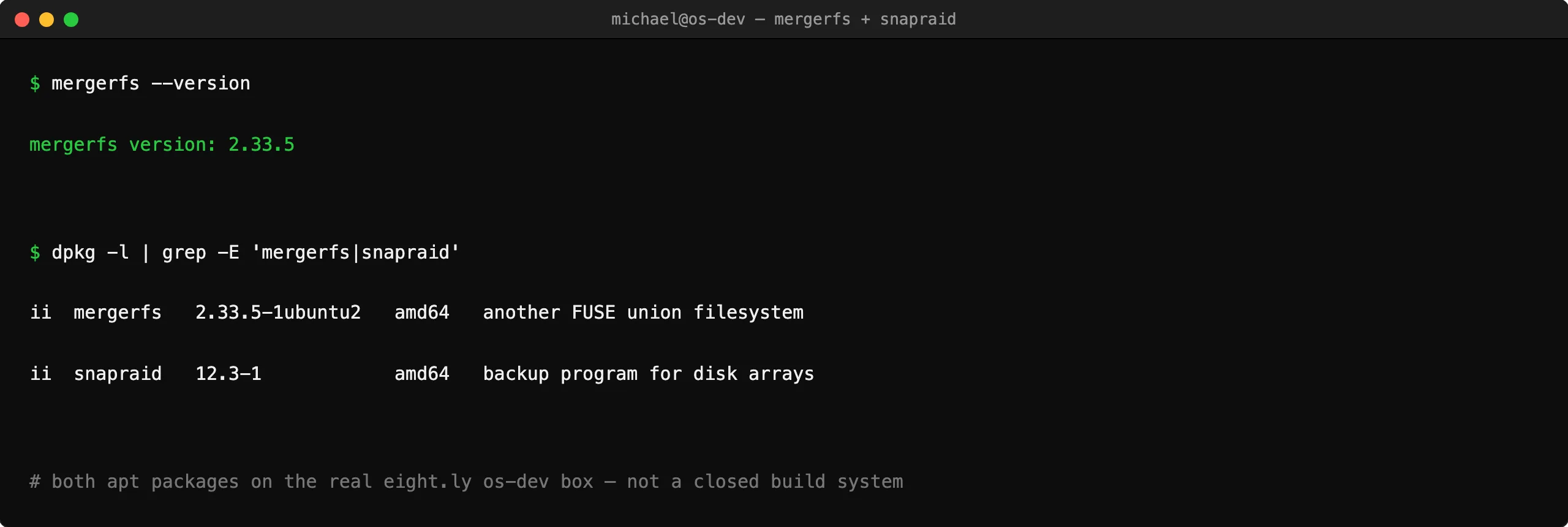
Eight.ly's storage engine runs on MergerFS and SnapRAID. Both are open source. Both have been stable for years. Neither is going anywhere, and nobody can close-source them out from under us.
Mixed-drive support is not on a roadmap waiting for a funded engineering project to ship. It works today. Your drives, any size, any mix, unified into one pool, protected against drive failure, with every individual file remaining readable on its own disk even in a worst-case scenario.
I wish the TrueNAS situation had gone differently. A lot of people in the home NAS space built on top of their work, and good software got hurt by this decision. But the architecture I chose (an independent stack, proven open-source components, no dependency on any vendor's roadmap) looks more right every week.