March 2, 2026
Why I built HomelabARR
From PGBlitz drama to a real software company. The complete story of how a project manager learned to code by rescuing a community project.
The PGBlitz era
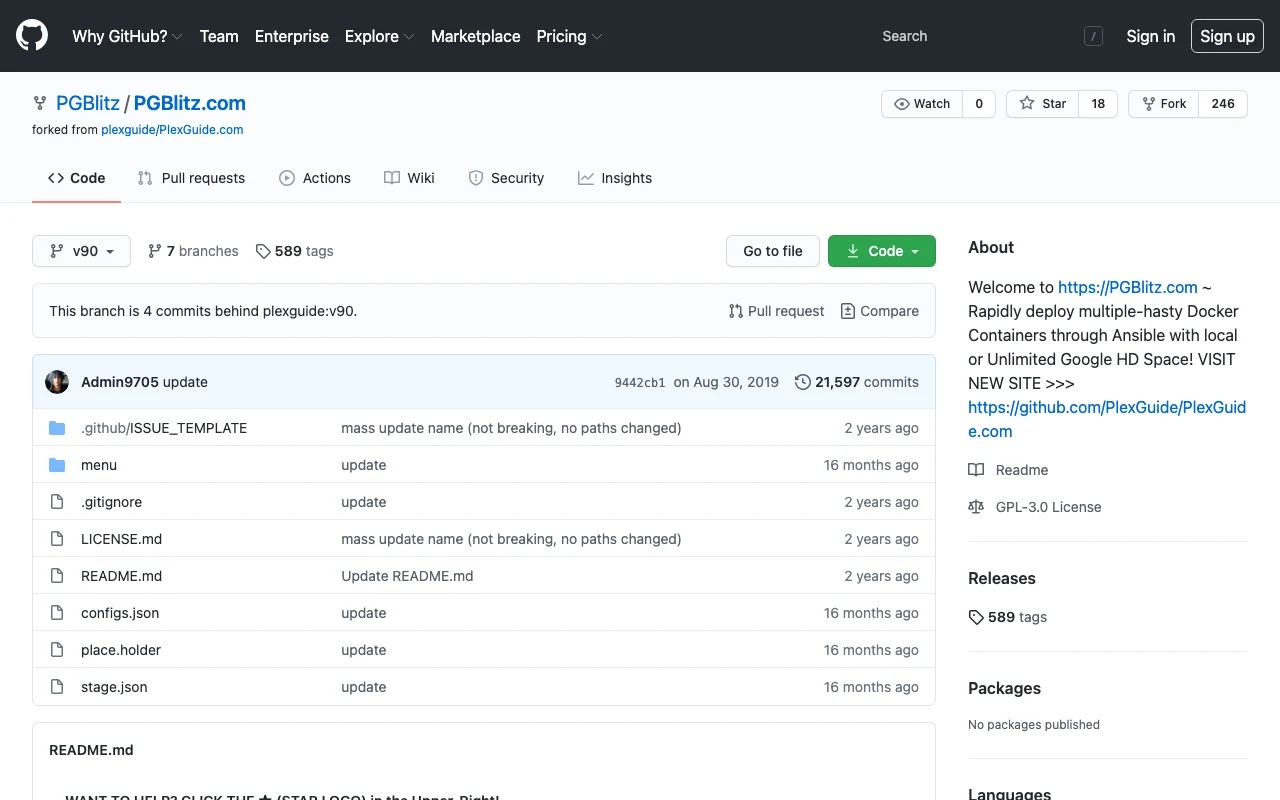
In 2017, a project called PlexGuide appeared in the homelab community. It promised easy media server setup: Plex, Sonarr, Radarr, cloud storage integration, all wrapped in scripts. It got big, with thousands of users and an active Discord.
It also had one problem that mattered more than all the features. One person controlled everything. The creator, known as "Admin," had a pattern: build a community, attract developers, disappear for months, come back, wipe everything, start over. The whole community lived on a fault line and most people didn't know it.
The collapse
On January 16, 2021, PlexGuide (by then rebranded as PGBlitz) vanished overnight. The Discord server, the forum, the website, all gone. Only the GitHub repos survived, and thousands of users woke up to nothing.
It got worse. A previous maintainer who had forked the project planted destructive code in the auto-updates. As one community member put it: "He literally put lines of code into nuke other peoples server via auto update." He destroyed the wiki and challenged people to find all the hooks he had left behind. So we had two failures stacked on top of each other: a creator who could delete the whole thing on a whim, and a saboteur who had wired the update channel to do real damage.
The reconstruction
A group of us spent over a month piecing it back together. Sammykins, a British server owner with a dry sense of humor, took ownership of the PTS repository to preserve it. Hawks led the technical reconstruction. iDoMnCi wrote conversion scripts. I was there too, a project manager by trade who had never written a line of code but knew how to organize chaos.
Sammykins set the tone: "I've got no reason to ever remove it because I can't code and I don't even use PTS anymore." That was the whole idea. Keep it alive forever, with no single point of failure and no one person who could delete everything.
What came out of that reconstruction is the lineage HomelabARR still carries. It descends from the PlexGuide and Dockserver scripts we rescued. I want to be clear about that, because the honest version of this story beats "lone genius builds NAS OS from scratch." I inherited a working community project that had been left for dead, and I kept building on it.
Learning to code
My day job was managing software teams, not writing software. I spent years as a Technical Project Manager and Senior TPM: leading 12 Scrum teams at Neptune Technology Group, managing SaaS portfolios at Healthcare Integrations, running networking deployments across six states at G5 TEK. PSM I, CSPO, SAFe 6 Agilist. I knew Jira, sprint planning, and SDLC inside and out, and I had never written a line of production code.
I started with YAML. Docker Compose configs for the projects, nothing more. Then I found bolt.new, bolt.diy, ChatGPT, Copilot, DeepSeek, Ollama. I tried every AI coding tool I could get my hands on. Eventually I landed on Claude and liked it enough to pay $200 a month for it.
The path was real and it was gradual: a PM who couldn't code, then YAML configs, then a JavaScript Docker management app, then a full Go rewrite with a React dashboard. No bootcamp. I built something people needed and learned what I had to learn to make it work. The PM half of my brain still did the heavy lifting. I could scope and prioritize and ship, and the AI covered the syntax I didn't have.
CE, PE, and the business
HomelabARR Community Edition is the part that grew straight out of the rescue: a Docker container manager with 117 pre-configured apps (it was higher once; I trimmed the dead and outdated ones down to a catalog I would actually stand behind). Free, open source, MIT licensed. That part stays exactly as it is, a labor of love for the community that survived PGBlitz. The Unraid Community Apps numbers are the proof it actually mattered to people: roughly 21,000 combined downloads across the two HomelabARR apps in grtgbln's repo, sustained over 15 months. The frontend template came from nwithan8. None of that is mine alone, and that is the point of the project.
The harder problem I wanted to solve was NAS management with mixed drive sizes. If you have a 2TB, a 4TB, and an 8TB drive, traditional RAID forces you to waste space or buy matching hardware. Unraid solves this with parity but takes a write-speed penalty for it. SnapRAID plus MergerFS solves it differently: full-speed writes, any drive sizes, add drives whenever you want.
That became HomelabARR PE, the Professional Edition. A single Go binary with an embedded React dashboard: storage management, Docker orchestration, file sharing, network config, monitoring. Everything a homelab NAS needs in one download. I priced it at $39/$79/$149 because Unraid charges $49-$249 and HexOS charges $199-$299, and I wanted to sit clearly under both.
That work pulled in everything else I am building now: HomelabARR PE, an iOS wellness app called NeuroHelper (currently in App Store review), and an open source AI operator toolkit I keep public, with Claude as the engineering partner on each of them.
The lessons
The PGBlitz story taught me most of what I needed to know about building software for other people:
- Single ownership is dangerous. Projects can vanish overnight, which is why open source and community governance matter.
- Trust is earned slowly and lost instantly. One destructive auto-update can poison an entire ecosystem.
- Documentation has to be preserved. When the wiki got destroyed, it set the community back months.
- Users must control their own systems: no forced updates, no phone-home, no kill switches.
- Ship the thing. Perfect plans don't help anyone, but a shipped v1 does.
HomelabARR exists because a community got burned and someone decided to keep building on what was left. That someone happened to be a project manager who taught himself to code with AI, while job hunting on the side.